Triple Negative Breast Cancer Is Changing
Triple negative breast cancer, commonly called TNBC, is one of the most challenging forms of breast cancer. It accounts for approximately 10 to 15 percent of breast cancers.
The term “triple negative” means that the cancer lacks the three traditional breast cancer treatment targets: estrogen receptor, progesterone receptor and HER2 overexpression or amplification.
Historically, this left physicians with fewer targeted treatments, and chemotherapy became the foundation of treatment.
That picture has changed substantially.
In 2026, triple negative breast cancer should no longer automatically be considered a cancer without therapeutic targets. Immunotherapy, antibody drug conjugates, PARP inhibitors, germline genetic testing and increasingly sophisticated molecular testing have created additional treatment opportunities.
The important question is no longer simply, “Which chemotherapy should we use?”
The more sophisticated question is:
What is biologically driving this patient’s cancer, and is there a therapeutic vulnerability that can be targeted?
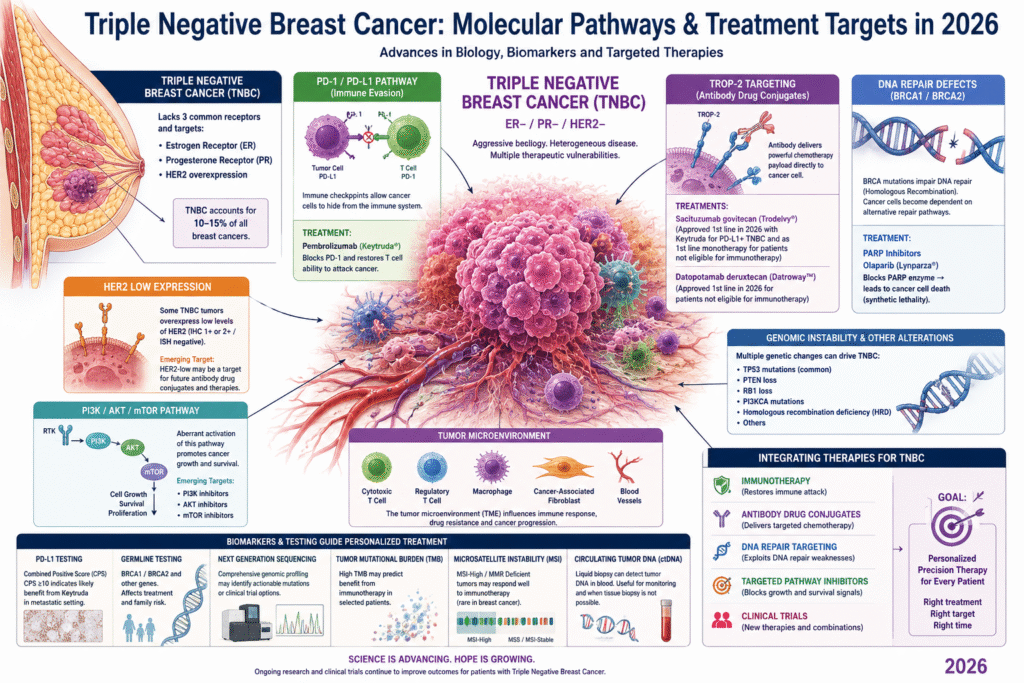
Why Triple Negative Breast Cancer Is Not One Disease
Two women can both have pathology reports showing triple negative breast cancer while having cancers with very different biology.
Their cancers may differ in BRCA1 or BRCA2 status, homologous recombination repair, PD L1 expression, immune activity, Trop 2 expression, HER2 expression at low levels, PI3K and AKT pathway alterations and numerous other molecular characteristics.
These differences can influence treatment.
This is why modern TNBC management increasingly combines traditional pathology with genetic and molecular information.
Treatment Begins With Accurate Staging
Treatment depends greatly upon whether TNBC is localized, locally advanced or metastatic.
For many patients with stage II or III TNBC, systemic treatment begins before surgery. This is called neoadjuvant therapy.
There are important reasons for treating before surgery.
Systemic therapy begins attacking both the primary tumor and possible microscopic cancer cells elsewhere in the body.
It also allows physicians to observe how the tumor responds.
Most importantly, examination of the surgical specimen after treatment provides valuable biological and prognostic information.
Keytruda and Early Stage Triple Negative Breast Cancer
Pembrolizumab, commercially known as Keytruda, is an immune checkpoint inhibitor targeting PD 1.
Cancer cells can exploit immune checkpoint pathways to suppress the immune system’s ability to recognize and destroy malignant cells.
Blocking PD 1 can restore antitumor immune activity in appropriate patients.
The KEYNOTE 522 trial established perioperative pembrolizumab combined with chemotherapy as an important treatment for appropriate patients with high risk early stage TNBC.
Treatment begins before surgery with pembrolizumab and chemotherapy.
Surgery follows.
Pembrolizumab is subsequently continued after surgery according to the established treatment protocol when clinically appropriate.
One important point is frequently misunderstood.
PD L1 positivity is not required for the early stage KEYNOTE 522 approach in the same manner that PD L1 testing is used to select certain patients with metastatic TNBC.
Pathologic Complete Response
One of the most important pieces of information obtained after neoadjuvant treatment is whether the patient achieved a pathologic complete response.
Pathologic complete response, commonly abbreviated pCR, means that no residual invasive cancer is identified in the breast and sampled regional lymph nodes under the applicable definition.
This matters because TNBC patients who achieve pCR generally have substantially better long term outcomes than patients who have significant residual invasive disease.
The surgical pathology therefore becomes more than simply a description of what was removed.
It provides important information about how sensitive the cancer was to systemic treatment.
Residual Cancer After Neoadjuvant Treatment
When invasive TNBC remains at surgery, the risk of recurrence is generally greater than when a pathologic complete response has occurred.
Additional treatment may therefore be considered depending upon the previous treatment, germline genetics, pathology and individual clinical circumstances.
Capecitabine, commercially known as Xeloda, has an established role in selected patients with residual HER2 negative breast cancer after neoadjuvant chemotherapy, particularly TNBC.
For appropriately selected patients with a germline BRCA1 or BRCA2 pathogenic variant and high risk HER2 negative early breast cancer, olaparib, commercially known as Lynparza, represents another important postoperative treatment.
These examples demonstrate why both the surgical pathology and germline genetic information can affect treatment after surgery.
BRCA1 and BRCA2 Are More Than Hereditary Cancer Tests
BRCA1 and BRCA2 are critically involved in DNA repair.
Cancer cells containing certain BRCA abnormalities can become dependent upon alternative mechanisms for repairing damaged DNA.
This creates a therapeutic vulnerability.
PARP inhibitors interfere with another DNA repair pathway.
When PARP is inhibited in an appropriate BRCA deficient cancer cell, DNA damage can accumulate until the cancer cell can no longer survive.
This concept is known as synthetic lethality.
Olaparib has demonstrated clinical benefit in appropriately selected patients with germline BRCA associated HER2 negative breast cancer.
Germline testing therefore can do considerably more than estimate hereditary cancer risk.
It can directly affect treatment.
It may also have important implications for family members.
Metastatic Triple Negative Breast Cancer Requires Another Biological Assessment
Once TNBC becomes recurrent, unresectable or metastatic, the treatment strategy changes.
Whenever clinically reasonable, obtaining tissue from recurrent or metastatic disease can be valuable.
Cancer evolves.
The metastatic cancer present years after the original diagnosis may not have exactly the same biological characteristics as the original breast tumor.
ER, PR and HER2 should therefore be reconsidered when appropriate.
Additional biomarker and genomic testing may also reveal new therapeutic possibilities.
PD L1 Testing in Metastatic TNBC
PD L1 testing has an established role in metastatic TNBC.
For pembrolizumab based treatment in this setting, an important biomarker is the combined positive score, or CPS.
For appropriate first line metastatic TNBC treatment with pembrolizumab, a PD L1 CPS of at least 10 using an FDA approved test has been an important treatment selection criterion.
This illustrates an essential principle.
The same drug can have different biomarker requirements in early stage and metastatic disease.
A Major 2026 Development: Trodelvy Plus Keytruda
Sacituzumab govitecan, commercially known as Trodelvy, is an antibody drug conjugate targeting Trop 2.
Trodelvy combines a Trop 2 directed antibody with a cytotoxic payload related to SN 38, the active metabolite of irinotecan.
The phase III ASCENT 04/KEYNOTE D19 trial evaluated Trodelvy plus pembrolizumab against chemotherapy plus pembrolizumab as first line treatment for PD L1 positive advanced TNBC.
The trial demonstrated a substantial improvement in progression free survival.
Median progression free survival was approximately 11.2 months with Trodelvy plus pembrolizumab compared with 7.8 months with chemotherapy plus pembrolizumab.
On June 24, 2026, the FDA approved sacituzumab govitecan in combination with pembrolizumab as first line treatment for adults with unresectable locally advanced or metastatic TNBC whose tumors express PD L1 with a CPS of at least 10 using an FDA approved test.
This is an important development because an antibody drug conjugate has moved directly into first line metastatic treatment.
Trodelvy First Line Monotherapy
Another important 2026 development involves patients who are not candidates for checkpoint inhibitor treatment.
The FDA also approved Trodelvy as first line monotherapy for adults with unresectable locally advanced or metastatic TNBC who are not candidates for PD 1 or PD L1 inhibitor therapy.
This further changes the traditional treatment sequence for metastatic TNBC.
Antibody drug conjugates are no longer therapies reserved exclusively for heavily pretreated disease.
Datroway: Another Major 2026 Advance
Datopotamab deruxtecan, commercially known as Datroway, is another Trop 2 directed antibody drug conjugate.
Datroway combines a Trop 2 directed antibody with a topoisomerase I inhibitor payload.
On May 22, 2026, the FDA approved Datroway for adults with unresectable or metastatic TNBC who are not candidates for PD 1 or PD L1 inhibitor therapy.
The approval was based upon results from the phase III TROPION Breast02 trial.
This represents another significant change in first line treatment for selected patients with metastatic TNBC.
What Is an Antibody Drug Conjugate?
Antibody drug conjugates represent one of the most important advances in modern oncology.
An antibody drug conjugate contains three major components.
The first is an antibody recognizing a target associated with the cancer cell.
The second is a linker.
The third is a potent cytotoxic drug.
The antibody helps concentrate delivery of the cytotoxic payload around cancer cells expressing the target.
For this reason, antibody drug conjugates are sometimes described as targeted chemotherapy, although their biology is considerably more sophisticated.
Trodelvy and Datroway both target Trop 2, but they are different drugs.
They have different molecular structures, payloads, clinical evidence and toxicity profiles.
They should not be considered interchangeable.
HER2 Negative Is Becoming More Complicated
Historically, breast cancers were frequently separated into HER2 positive and HER2 negative disease.
Antibody drug conjugates have made that classification more complicated.
Some cancers classified as HER2 negative still express small amounts of HER2 protein.
This has led to classifications such as HER2 low.
HER2 expression can also change as breast cancer evolves.
For this reason, reviewing the HER2 status of recurrent or metastatic tissue can sometimes reveal treatment possibilities that were not present or recognized at the original diagnosis.
A patient originally diagnosed with TNBC should therefore not necessarily assume that every future metastatic lesion will have identical receptor expression.
Why Rebiopsy Can Be Important
Cancer is genetically unstable.
Treatment itself creates selective pressure.
Sensitive cancer cells die while resistant clones can survive and expand.
Consequently, the biology of recurrent cancer can differ from the original tumor.
When safely obtainable and clinically useful, biopsy of recurrent or metastatic disease can reconfirm the diagnosis and permit repeat testing of ER, PR and HER2.
The tissue may also be used for genomic and biomarker testing.
A biopsy should be performed when the information obtained has a reasonable possibility of affecting management.
Next Generation Sequencing
Next generation sequencing can examine large numbers of cancer associated genes simultaneously.
Comprehensive genomic profiling may identify mutations, amplifications, deletions, fusions and other molecular abnormalities.
However, finding a mutation does not automatically mean that a proven treatment exists for it.
This distinction is extremely important.
A genomic alteration can be biologically interesting without being clinically actionable.
An actionable alteration may identify an approved treatment, provide evidence supporting another treatment strategy or qualify the patient for a clinical trial.
The purpose of genomic testing should therefore be to answer clinically meaningful questions rather than simply generating a long list of mutations.
Tumor Mutational Burden
Tumor mutational burden, or TMB, estimates the number of acquired mutations within a defined quantity of tumor DNA.
Some highly mutated cancers produce more abnormal proteins, called neoantigens, that potentially make the cancer more recognizable to the immune system.
High TMB can therefore have implications for immunotherapy in selected circumstances.
However, TMB should never be interpreted in isolation.
It must be considered together with the cancer type, clinical setting and other biomarkers.
Microsatellite Instability and Mismatch Repair
Mismatch repair proteins help correct errors occurring during DNA replication.
When this repair system fails, microsatellite instability can develop.
Tumors that are microsatellite instability high or mismatch repair deficient can sometimes be particularly responsive to immune checkpoint inhibition.
These abnormalities are uncommon in breast cancer.
Nevertheless, when present, they can be therapeutically important.
Circulating Tumor DNA and Liquid Biopsy
Cancer cells can release fragments of their DNA into the bloodstream.
This circulating tumor DNA is called ctDNA.
A blood test designed to analyze tumor derived DNA is commonly referred to as a liquid biopsy.
Liquid biopsy can sometimes identify molecular alterations without requiring another tissue biopsy.
This can be particularly valuable when metastatic tissue is difficult or unsafe to obtain.
However, liquid biopsy has limitations.
Not every cancer releases the same amount of DNA into the circulation.
A negative ctDNA test does not prove that cancer is absent.
Tissue biopsy and liquid biopsy should therefore be considered complementary technologies rather than universally interchangeable tests.
The Tumor Microenvironment
Cancer is not simply a collection of malignant cells.
Cancer exists within a complex biological environment containing immune cells, blood vessels, fibroblasts, extracellular matrix and signaling molecules.
This is called the tumor microenvironment.
TNBC can contain substantial immune cell infiltration.
The interaction between malignant cells and the immune system is one reason checkpoint inhibitors can be effective in selected TNBC patients.
Researchers are studying cytotoxic T cells, regulatory T cells, macrophages, cancer associated fibroblasts and numerous signaling pathways within this environment.
Future cancer treatment will increasingly target not only the cancer cell but also the biological environment supporting it.
Why Treatment Eventually Stops Working
Cancer treatment resistance is one of the central problems in oncology.
A treatment can initially produce dramatic tumor regression and subsequently stop working.
This does not necessarily mean that the original treatment was inappropriate.
Cancer evolves.
Resistant clones can survive and eventually dominate the tumor population.
Resistance can develop through changes in drug targets, alternative signaling pathways, enhanced DNA repair, drug efflux mechanisms, immune escape and changes in the tumor microenvironment.
When a cancer progresses, its biology should therefore be reconsidered.
Imaging and Molecular Testing Answer Different Questions
No single cancer test provides every answer.
Pathology tells us what the cancer is.
Imaging tells us where the cancer is located and how extensively it has spread.
Molecular testing can reveal biological vulnerabilities.
Blood testing can provide additional information about disease biology and, in some circumstances, molecular changes.
CT, MRI, PET imaging and other imaging techniques therefore remain important even as molecular oncology becomes increasingly sophisticated.
Precision oncology does not mean replacing conventional oncology.
It means integrating these different sources of information.
Clinical Trials
Triple negative breast cancer remains one of the most active areas of breast cancer research.
Clinical trials are investigating new antibody drug conjugates, immune therapies, combinations of antibody drug conjugates with checkpoint inhibitors, DNA repair strategies, targeted therapies and biomarker selected treatments.
Clinical trials should not necessarily be viewed only as a final option after every approved therapy has failed.
Some trials are designed specifically for earlier lines of therapy.
Patients with high risk or metastatic TNBC should discuss clinical trial eligibility with their oncology team when appropriate.
What Should Be Tested in Triple Negative Breast Cancer?
The appropriate testing differs according to disease stage and individual circumstances.
Important considerations can include confirmation of ER, PR and HER2 status, germline genetic testing including BRCA1 and BRCA2 when indicated, PD L1 testing in advanced disease, reassessment of metastatic tissue when appropriate, and comprehensive genomic profiling in selected advanced cancers.
Testing for additional biomarkers such as microsatellite instability and tumor mutational burden may occasionally identify uncommon but potentially important therapeutic opportunities.
The goal is not to order every available cancer test.
The goal is to identify information capable of changing treatment.
Triple Negative Does Not Mean There Are No Targets
This may be the most important concept for patients to understand.
The name “triple negative” describes the absence of three traditional breast cancer markers.
It does not mean that the cancer has no biology that can be targeted.
In 2026, therapeutic strategies can potentially exploit PD 1 and PD L1 immune biology, Trop 2 expression, BRCA associated DNA repair defects and other molecular vulnerabilities.
Research continues to identify additional targets.
The Future of Triple Negative Breast Cancer
The treatment of TNBC is moving toward increasingly individualized therapy.
The traditional model classified breast cancer primarily according to the organ in which it developed and several receptor measurements.
Modern oncology goes much deeper.
We can increasingly examine the molecular machinery operating inside the cancer.
We can study its DNA repair systems.
We can examine its interaction with the immune system.
We can identify proteins expressed on the surface of malignant cells.
We can sometimes detect tumor derived DNA circulating in the bloodstream.
We can then attempt to match these characteristics with treatments capable of exploiting particular vulnerabilities.
This is the foundation of precision oncology.
Conclusion
Triple negative breast cancer remains a serious and potentially aggressive disease.
But the therapeutic landscape in 2026 is considerably different from what it was even several years ago.
Chemotherapy remains important.
It is no longer the entire story.
Pembrolizumab has established an important role for immunotherapy.
Olaparib provides targeted treatment for appropriately selected patients with germline BRCA associated disease.
Antibody drug conjugates have substantially changed metastatic TNBC treatment.
The 2026 first line developments involving Trodelvy and Datroway represent another significant change in how advanced TNBC can be treated.
The words “triple negative” should therefore be the beginning of the biological investigation, not the end of it.
The central question in modern cancer treatment is increasingly:
What is biologically unique about this cancer, and can that information reveal a better way to attack it?
Educational Disclaimer
The information provided on this website is for educational purposes only. It does not constitute medical advice, diagnosis, treatment, or prescribing.
Cancer treatment must be individualized. Patients should discuss treatment decisions with their treating oncologist after review of their complete pathology, imaging, laboratory studies, genetic testing, molecular testing, previous treatments and overall medical condition.
This educational material does not establish a physician patient relationship.
Dr. Silver, MD
Selected Medical References
Schmid P, Cortes J, Pusztai L, et al. Pembrolizumab for Early Triple Negative Breast Cancer. New England Journal of Medicine. 2020;382:810-821.
Schmid P, Cortes J, Dent R, et al. Event free survival with pembrolizumab in early triple negative breast cancer. New England Journal of Medicine. 2022;386:556-567.
Cortes J, Rugo HS, Cescon DW, et al. Pembrolizumab plus chemotherapy in advanced triple negative breast cancer. New England Journal of Medicine. 2022;387:217-226.
Tutt ANJ, Garber JE, Kaufman B, et al. Adjuvant olaparib for patients with BRCA1 or BRCA2 mutated breast cancer. New England Journal of Medicine. 2021;384:2394-2405.
Masuda N, Lee SJ, Ohtani S, et al. Adjuvant capecitabine for breast cancer after preoperative chemotherapy. New England Journal of Medicine. 2017;376:2147-2159.
Bardia A, Hurvitz SA, Tolaney SM, et al. Sacituzumab govitecan in metastatic triple negative breast cancer. New England Journal of Medicine. 2021;384:1529-1541.
Bardia A, et al. Sacituzumab govitecan plus pembrolizumab versus chemotherapy plus pembrolizumab for previously untreated PD L1 positive advanced triple negative breast cancer. ASCENT 04/KEYNOTE D19. Phase III study, 2025-2026.
U.S. Food and Drug Administration. Datopotamab deruxtecan dlnk for unresectable or metastatic triple negative breast cancer. FDA approval, May 22, 2026.
U.S. Food and Drug Administration. Sacituzumab govitecan hziy first line indications for unresectable locally advanced or metastatic triple negative breast cancer. FDA approval, June 24, 2026.
National Comprehensive Cancer Network. NCCN Clinical Practice Guidelines in Oncology: Breast Cancer. Current 2026 version.
American Society of Clinical Oncology. Current breast cancer treatment guidelines and rapid recommendation updates. 2026.