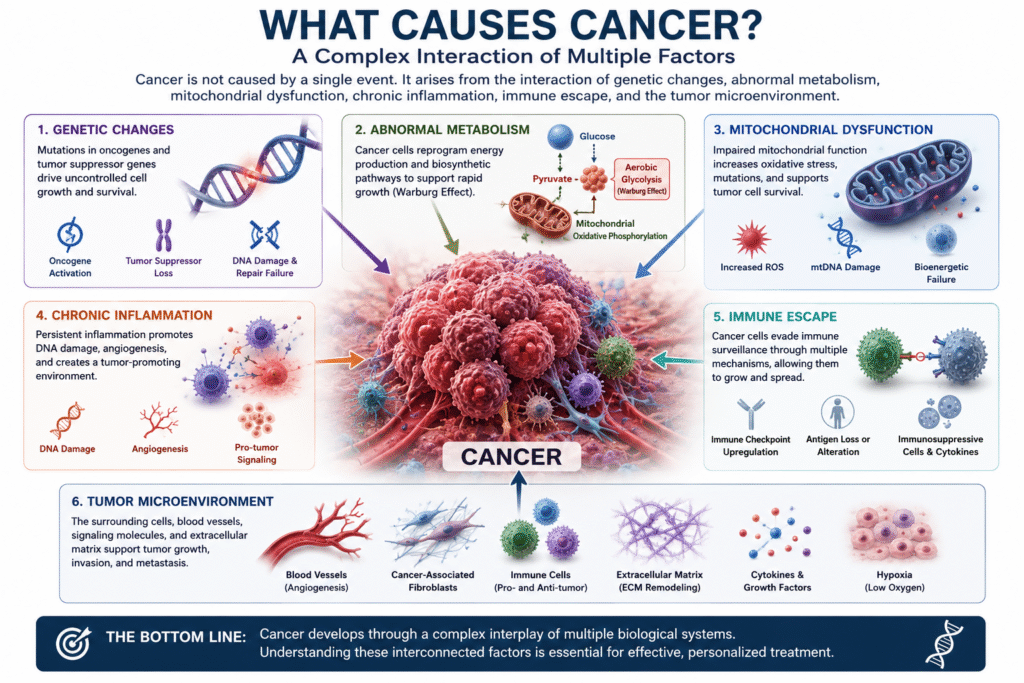
What causes cancer? There is no single answer. Cancer develops through a complex interaction of genetic changes, abnormal metabolism, mitochondrial dysfunction, chronic inflammation, immune escape, and the tumor microenvironment.
Understanding these factors helps explain why two people with cancer in the same organ can have very different diseases and respond differently to treatment.
Genetics and Cancer
Cancer cells develop abnormalities in genes that control growth, cell division, DNA repair, and programmed cell death.
Some mutations activate pathways that encourage cancer growth. Others disable mechanisms that normally suppress abnormal cells.
This is one reason molecular testing and next-generation sequencing have become important in modern oncology. Identifying the mutations and pathways driving a particular cancer can sometimes reveal specific treatment targets.
But mutations are not the entire story.
Mitochondria and Cancer
Mitochondria are structures inside cells that produce much of the energy needed for normal cellular function.
When mitochondrial function becomes abnormal, cellular metabolism can change. Mitochondrial dysfunction can interact with oxidative stress, inflammation, abnormal cellular signaling, and genetic instability.
Researchers continue to investigate whether mitochondrial dysfunction is simply a consequence of cancer or whether it may contribute to the development of some cancers.
This remains an evolving area of science. It does not replace the established importance of genetics or proven cancer treatment.
Cancer Metabolism and the Warburg Effect
Cancer cells frequently process energy differently from normal cells.
Nearly a century ago, Otto Warburg observed that many cancer cells consume large amounts of glucose and rely heavily on glycolysis even when oxygen is available. This became known as the Warburg effect.
This does not mean that eating sugar directly causes cancer.
It means that cancer metabolism is abnormal.
Blood glucose, insulin, insulin resistance, obesity, and metabolic health can influence the biological environment in which some cancers grow. Cancer cells can also use fuels other than glucose, including glutamine.
Cancer metabolism is therefore much more complicated than simply trying to eliminate sugar.
Inflammation and Cancer
Inflammation is necessary for healing and fighting infection. The problem develops when inflammation becomes chronic.
Persistent inflammation can increase oxidative stress, damage tissues, alter cellular signaling, interfere with immune function, and change the tumor microenvironment.
Chronic inflammation may therefore help create conditions that allow cancer cells to survive and progress.
Reducing unnecessary chronic inflammation is important for overall health, but it should never be considered a replacement for cancer treatment.
The Immune System and Cancer
The immune system constantly monitors the body for abnormal cells. This process is called immune surveillance.
Natural killer cells, T lymphocytes, dendritic cells, macrophages, and other immune cells participate in recognizing and eliminating abnormal cells.
Cancer cells can sometimes escape this surveillance.
Some tumors suppress immune cells. Others alter the signals that would normally identify them as abnormal. Tumors can also create a local environment that makes immune cells less effective.
Understanding these mechanisms helped lead to modern cancer immunotherapy.
Oxygen and the Tumor Environment
A tumor is not simply a mass of cancer cells.
It exists within a complex tumor microenvironment containing blood vessels, immune cells, connective tissue, nutrients, signaling molecules, and areas with different oxygen levels.
As a tumor grows, some regions can become deficient in oxygen. This is called hypoxia.
Hypoxia can activate HIF 1 alpha, a signaling protein that helps cancer cells adapt to low oxygen. It can increase glucose metabolism, promote new blood vessel formation, interfere with immune activity, and contribute to treatment resistance.
This illustrates an important principle. Cancer cells constantly interact with the environment around them.
Why Personalized Cancer Testing Matters
Cancer is not one size fits all.
Two patients can have the same type and stage of cancer but have very different molecular characteristics.
Modern oncology can therefore ask much more than simply where the cancer originated.
What mutations are present?
Which pathways are driving the cancer?
Are there actionable molecular targets?
Could targeted therapy be appropriate?
Are biomarkers present that may predict response to immunotherapy?
Can circulating tumor DNA provide useful additional information?
These questions may require tissue biopsy, pathology, next generation sequencing, molecular testing, blood testing, and appropriate imaging.
No single test provides every answer.
What Causes Cancer? The Bottom Line
Cancer cannot be reduced to one theory.
Genetics matters. Metabolism matters. Mitochondrial biology matters. Inflammation matters. The immune system matters. The tumor microenvironment matters.
These systems interact continuously.
Instead of asking only, “What caused my cancer?” another important question is:
What is driving my cancer now, and what can we learn about its biology that may help guide treatment?
That is one of the central ideas behind precision oncology and personalized cancer care.
Personalized Cancer Education and Coaching
For information about a personalized cancer education and coaching consultation, contact:
Medical Disclaimer
The information provided on this website is for educational purposes only. It does not constitute medical advice, diagnosis, treatment, or prescribing. It does not create a physician patient relationship. Cancer diagnosis and treatment decisions should be made with your treating oncologist or other qualified healthcare professional.