Cancer treatment is becoming increasingly personalized; this is where we can use molecular and genetic testing.
Two people may have cancers that begin in the same organ and look similar under a microscope, yet the molecular biology of their tumors may be very different. One tumor may be driven by a particular genetic alteration, while another may depend on a completely different signaling pathway.
Molecular and genomic testing helps physicians look beneath the traditional diagnosis to examine some of the biological characteristics that may be driving an individual cancer.
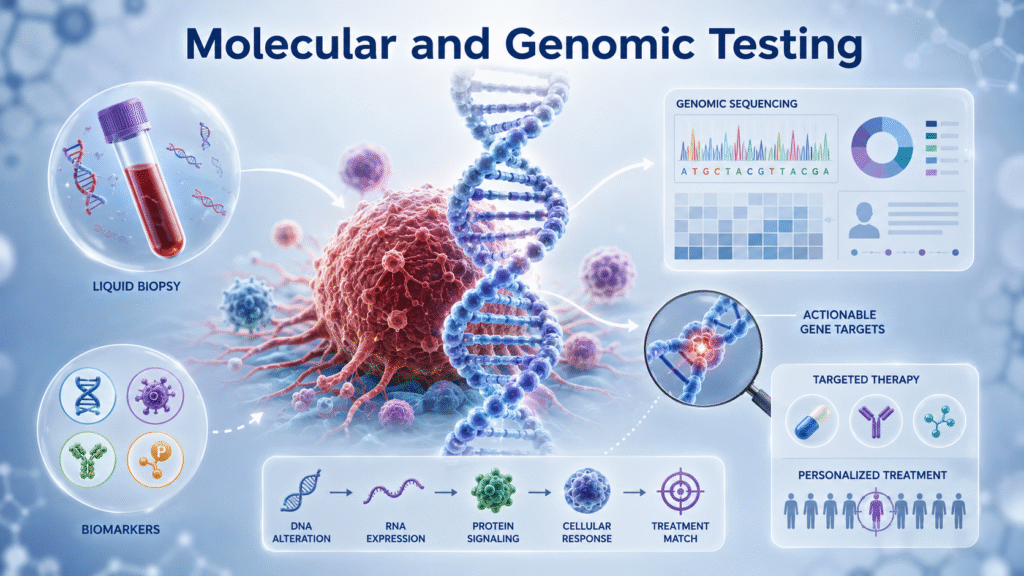
These tests may look for genetic mutations, changes in gene expression, proteins, receptors, immune biomarkers, and other molecular abnormalities. This information may sometimes help physicians select treatments more precisely. The National Cancer Institute describes biomarker testing as testing for genes, proteins, and other substances that can provide information about a person’s cancer and may help guide treatment.
Why Molecular and Genomic Testing Matters
Traditional pathology remains essential. A biopsy establishes the type of cancer and provides important information about tumor characteristics.
But cancers that look similar under the microscope can behave differently at the molecular level.
Cancer cells may contain genetic alterations and abnormal signaling pathways that influence how they grow, survive, spread, interact with the immune system, and respond to treatment. Genomic alterations can dysregulate pathways involved in cancer-cell growth and survival.
The purpose of molecular and genomic testing is to obtain a more detailed biological picture of the cancer and identify findings that may be clinically useful.
Molecular and Genomic Testing: Understanding DNA
DNA contains the genetic instructions that help regulate cell growth, repair, communication, and death.
Cancer develops when important cellular controls become disrupted. A tumor may contain many genetic alterations, but not every alteration has the same significance.
Some abnormalities are known as driver alterations because they contribute to cancer growth or survival.
Others may be present without being responsible for driving the disease.
Examples of genes that may be important in selected cancers include:
EGFR
HER2
KRAS
BRAF
BRCA1 and BRCA2
PIK3CA
ALK
ROS1
RET
NTRK
ESR1
IDH1 and IDH2
The importance of a particular alteration depends on the type of cancer, stage, previous treatment, and clinical situation.
Finding a mutation does not automatically mean that an effective treatment exists for it.
What Is Next Generation Sequencing?
One of the major advances in molecular and genomic testing is next generation sequencing, commonly called NGS.
NGS allows laboratories to examine many cancer-associated genes at the same time rather than testing one gene individually.
Depending on the test, NGS may identify abnormalities such as:
- mutations
- amplifications
- deletions
- gene rearrangements
- gene fusions
- other genomic alterations
The purpose is not simply to produce a long list of genetic changes.
The important question is:
Does any finding provide clinically useful information?
Genomic profiling may help identify tumor mutations and other genetic changes that could influence treatment planning.
What Is an Actionable Mutation?
An actionable mutation is a molecular alteration for which there is evidence that the finding may influence a clinical decision.
That could mean:
- an approved targeted therapy may be available
- a treatment may be less likely to work
- another drug may be preferable
- a clinical trial may target the alteration
- additional testing may be appropriate
Not every mutation is actionable.
And even when a targeted drug exists, the effectiveness of that drug may depend on the type of cancer in which the mutation is found.
DNA Does Not Tell the Entire Story
DNA reveals which genetic instructions are present.
But it does not always tell us which of those instructions are actively being used.
That is where RNA analysis can provide additional information.
A simple way to think about this is to imagine DNA as a cookbook containing thousands of recipes.
Having a recipe in the cookbook does not mean that recipe is currently being prepared.
RNA provides information about which genetic instructions are being expressed.
Molecular diagnostics can therefore examine not only a tumor’s genome, or DNA, but also its transcriptome, including messenger RNA, and proteins produced by the tumor.
Molecular and Genomic Testing and Cancer Biomarkers
Cancer biomarkers include genes, proteins, receptors, and other measurable characteristics of a tumor.
Some biomarkers can directly affect treatment decisions.
Examples include:
ER and PR in breast cancer
HER2 in several cancers
PD-L1 in selected tumor types
MSI-H or mismatch repair deficiency
Tumor mutational burden, or TMB, in selected circumstances
Biomarker testing may sometimes help determine whether hormone therapy, targeted therapy, immunotherapy, or another treatment could be appropriate.
For additional patient information about biomarker testing, visit the National Cancer Institute.
Tumor Mutations Are Different From Inherited Mutations
This is an important distinction.
A somatic mutation develops within cancer cells during a person’s lifetime.
A germline mutation is an inherited genetic alteration that is present throughout the body and may increase inherited cancer risk.
Tumor genetic testing and inherited genetic testing are therefore not the same thing.
The National Cancer Institute notes that tumor genetic testing can sometimes detect an inherited alteration, but tumor testing does not replace appropriate germline testing for inherited cancer risk.
This distinction can be important not only for the patient but sometimes for biological relatives.
How Molecular and Genomic Testing May Guide Targeted Therapy
Targeted therapies are designed to interfere with particular molecules or pathways involved in cancer growth or survival.
If molecular and genomic testing identifies an actionable alteration, a physician may sometimes select treatment directed toward that molecular abnormality.
This concept forms part of modern precision oncology.
Instead of looking only at the organ where a cancer began, physicians may also investigate the molecular mechanisms driving that particular tumor.
For an overview of the major treatment categories, see our Cancer Treatment Approaches page.
Cancer Can Change Over Time
Cancer is not always biologically static.
Tumors can evolve under treatment pressure.
Chemotherapy, targeted therapy, hormone therapy, immunotherapy, and other treatments may kill sensitive cancer cells while resistant populations survive.
As those populations grow, the molecular characteristics of the cancer may change.
This can sometimes produce:
- new resistance mutations
- activation of alternative pathways
- loss or gain of biomarkers
- altered sensitivity to treatment
For that reason, repeat molecular testing or another biopsy may sometimes be considered when cancer progresses.
Liquid Biopsy and Molecular Testing From Blood
Not all molecular testing requires tumor tissue.
Cancer cells can release genetic material into the bloodstream. A portion of this cell-free DNA may originate from the tumor and is known as circulating tumor DNA, or ctDNA.
A liquid biopsy may analyze ctDNA for tumor-associated genetic abnormalities.
Liquid biopsy can be useful in selected clinical situations, but its capabilities and limitations vary substantially. Some ctDNA assays have demonstrated clinical utility in particular advanced cancers, while evidence remains insufficient for many other applications.
Liquid biopsy may be used or studied to:
- identify certain mutations
- help select targeted therapies
- identify emerging resistance
- monitor molecular changes during treatment
- evaluate residual disease in certain settings
- investigate recurrence
A negative liquid biopsy does not necessarily mean that cancer is absent.
Some tumors release very little DNA into the bloodstream, so tissue testing may still be necessary.
Circulating Tumor Cells
Circulating tumor cells, or CTCs, are different from ctDNA.
CTCs are whole cancer cells that have entered the bloodstream.
ctDNA consists of fragments of tumor-derived DNA circulating in blood.
Both are being studied as part of the broader field of liquid biopsy and precision cancer monitoring.
Molecular and Genomic Testing Does Not Replace Pathology
Molecular and genomic testing is an additional tool, not a substitute for the rest of oncology.
Cancer treatment decisions may depend on a combination of:
- pathology
- cancer type
- stage
- imaging
- laboratory findings
- previous treatment
- performance status and overall health
- biomarkers
- genomic findings
No single molecular test provides every answer.
The results need to be interpreted within the complete clinical picture.
Understanding Your Test Report
Molecular reports can be complicated and may contain dozens or hundreds of findings.
Patients should not assume that every abnormal result requires treatment.
Useful questions to ask the oncology team include:
Which findings are actually driving my cancer?
Are any of these mutations actionable?
Is there an approved treatment directed at this alteration in my type of cancer?
Could any finding explain resistance to my current treatment?
Are there biomarkers suggesting possible immunotherapy benefit?
Does anything on this report suggest that germline genetic testing should be considered?
Are there clinical trials targeting these abnormalities?
Should molecular testing be repeated if my cancer progresses?
The objective is not to obtain the largest possible report.
The objective is to obtain information that may improve clinical decision-making.
The Future of Testing
Cancer treatment is increasingly moving away from a completely one-size-fits-all approach.
The organ where a cancer begins and the stage of disease remain fundamental, but physicians can now investigate many of the molecular features driving an individual tumor.
DNA sequencing, RNA analysis, biomarkers, and liquid biopsy are helping expand precision oncology.
The goal is straightforward:
Find the right treatment for the right patient at the right time.
Not every patient needs every available molecular test.
Not every mutation has a treatment.
But when appropriately selected and correctly interpreted, molecular and genomic testing can provide valuable information for personalized cancer care.
Educational Disclaimer
This article is provided for educational purposes only and does not constitute medical advice, diagnosis, treatment, or prescribing.
The information is not intended to replace the advice of a licensed treating physician, medical oncologist, surgeon, radiation oncologist, genetic counselor, or other qualified healthcare professional.
Molecular and genomic testing is not appropriate or clinically useful in every situation. Test results should be interpreted in the context of the patient’s pathology, cancer type, stage, treatment history, overall health, and other clinical findings.
No physician-patient relationship is created through this website, article, email communication, social media, or educational coaching.
Patients should discuss diagnostic testing and treatment decisions with their own licensed treating physicians.
Dr. Dean Silver, MD MD (H)
References
- Collins FS, Varmus H. A New Initiative on Precision Medicine. New England Journal of Medicine. 2015;372(9):793-795.
- Garraway LA. Genomics-Driven Oncology: Framework for an Emerging Paradigm. Journal of Clinical Oncology. 2013;31(15):1806-1814.
- Merker JD, Oxnard GR, Compton C, et al. Circulating Tumor DNA Analysis in Patients With Cancer: American Society of Clinical Oncology and College of American Pathologists Joint Review. Journal of Clinical Oncology. 2018;36(16):1631-1641.
- National Cancer Institute. Biomarker Testing for Cancer Treatment. U.S. National Institutes of Health.
- National Cancer Institute. Genetic Testing for Inherited Cancer Risk. U.S. National Institutes of Health.
- National Cancer Institute. Molecular Diagnostics for Cancer Treatment: Completing the Picture. U.S. National Institutes of Health.
- National Cancer Institute. Genomic Profiling. NCI Dictionary of Cancer Terms.
- National Cancer Institute. Tumor Markers. U.S. National Institutes of Health.