Understanding Your Cancer Biology: Why Every Cancer Is Different
Two patients can be diagnosed with what appears to be the same cancer and still have very different diseases.
They may have cancer in the same organ, the same stage, and even similar pathology reports, but their tumors can contain different genetic mutations, receptors, molecular pathways, immune characteristics, metabolic behavior, and mechanisms of treatment resistance.
That is why one of the most important questions in modern oncology is no longer simply:
“Where is the cancer?”
It is also:
“What is driving this particular cancer?”
Modern precision oncology increasingly looks at the biological characteristics of an individual tumor to help determine which treatments may be most appropriate.
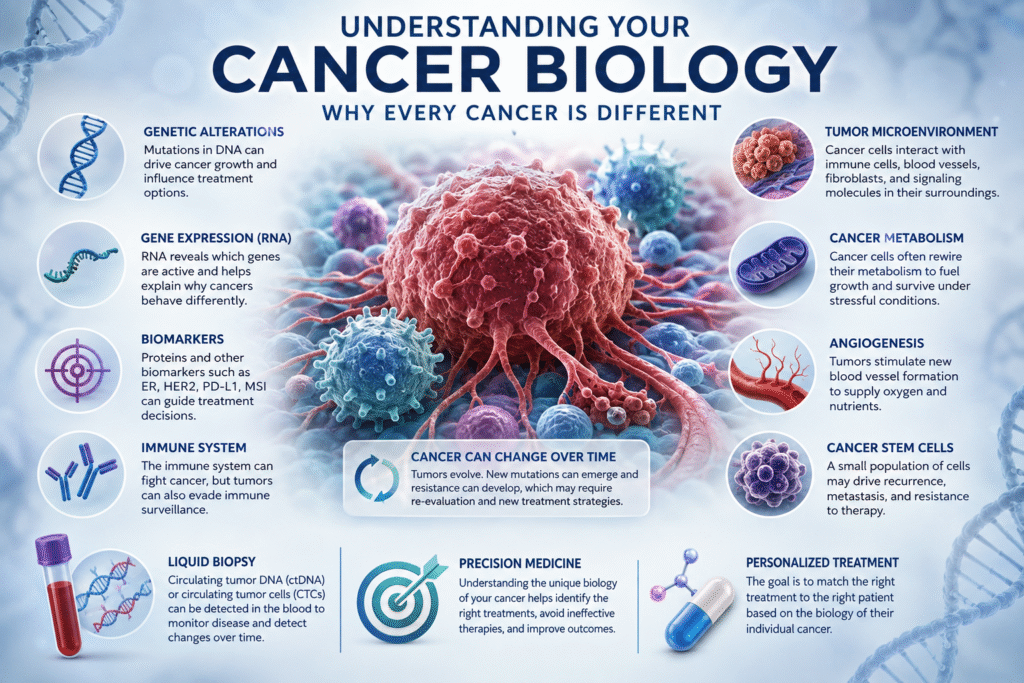
Cancer Is More Than a Tumor on a Scan
CT scans, MRI, PET scans, pathology, and physical examination remain fundamental parts of cancer diagnosis and monitoring.
But a visible tumor is only one part of the disease.
Beneath what we can see on imaging are biological processes involving DNA mutations, altered cellular signaling, immune interactions, blood-vessel formation, metabolism, inflammation, the tumor microenvironment, and sometimes microscopic residual disease.
Cancer is not simply a mass of abnormal cells. It is a complex biological system. Understanding cancer biology means looking beyond the location of the tumor and examining the molecular, genetic, immune, and metabolic features that may influence how it behaves.
Your Cancer’s Genetic Blueprint
Every cell contains DNA, which carries the instructions controlling cellular growth, repair, communication, and death.
Cancer develops when those controls become disrupted.
But not every mutation found inside a cancer cell is equally important.
Some mutations may be present without meaningfully driving the cancer. Others, called driver mutations, can directly promote cancer growth or survival.
Examples of molecular alterations that may influence treatment in selected cancers include:
EGFR
HER2
BRAF
KRAS
BRCA1 and BRCA2
PIK3CA
ALK
ROS1
RET
NTRK
ESR1
IDH1 and IDH2
Which genes matter depends on the type of cancer and the individual patient.
Why Next Generation Sequencing May Matter
Traditional pathology tells us what a tumor looks like under the microscope.
Next generation sequencing, or NGS, can look deeper into the molecular characteristics of the cancer.
NGS can examine many cancer-associated genes at the same time and may identify:
- mutations that are helping drive tumor growth
- potential molecular treatment targets
- mechanisms of treatment resistance
- alterations that may suggest the need for inherited genetic testing
- biomarkers that could make a patient eligible for certain targeted therapies or clinical trials
Not every mutation has an available treatment, and not every patient needs extensive genomic testing. But in appropriate situations, NGS can provide information that cannot be obtained from imaging alone.
DNA Does Not Tell the Entire Story
Finding a mutation does not automatically mean that mutation is actively controlling the cancer.
DNA can be thought of as the instruction manual inside the cell.
RNA provides information about which genetic instructions are actively being used.
Two tumors may contain similar DNA alterations yet behave differently because different pathways are switched on or off.
RNA and gene-expression analysis can therefore provide additional information about tumor activity, aggressiveness, immune biology, and treatment resistance.
Together, DNA and RNA testing can sometimes provide a more complete picture of the cancer than either test alone.
Biomarkers Can Change Treatment
Cancer cells may also carry proteins and other biomarkers that directly influence treatment decisions.
Examples include:
ER and PR in breast cancer
HER2 in breast, gastric, and other cancers
PD-L1 in several tumor types
MSI-H or mismatch repair deficiency
Tumor mutational burden, or TMB, in selected situations
These biomarkers can sometimes help determine whether hormone therapy, HER2-directed therapy, immunotherapy, targeted therapy, or another strategy may be appropriate.
The value of each biomarker depends on the type of cancer and the clinical situation.
The Tumor Microenvironment Matters
A tumor does not exist by itself.
Cancer cells live within a complex biological environment containing:
- immune cells
- blood vessels
- fibroblasts and stromal cells
- extracellular matrix
- inflammatory molecules
- oxygen gradients
- nutrients
- signaling proteins
This is called the tumor microenvironment.
The interaction between cancer cells and their surrounding environment can influence whether a tumor grows, spreads, avoids immune attack, or becomes resistant to treatment.
For additional information about biomarker testing and precision medicine, visit the National Cancer Institute.
The Immune System Is Part of Cancer Biology
The immune system constantly monitors the body for abnormal cells.
Cancer, however, can develop mechanisms that allow it to escape immune surveillance.
Some tumors suppress immune-cell activity. Others use immune checkpoint pathways such as PD-1 and PD-L1 to reduce an effective immune response.
This biology led to the development of immune checkpoint inhibitors.
Rather than directly killing cancer cells in the same way as traditional chemotherapy, these therapies can help remove inhibitory signals that prevent immune cells from attacking the tumor effectively.
Understanding the immune biology of a cancer may therefore be important in determining whether immunotherapy could be useful.
Cancer Metabolism Is Also Different
Cancer cells frequently change the way they produce and use energy.
One well-known example is the Warburg effect, in which many cancer cells rely heavily on glycolysis even when oxygen is available.
Cancer metabolism is much more complicated than simply saying that cancer “feeds on sugar.”
Tumors may use glucose, glutamine, fatty acids, and other nutrients depending on their biology and environment.
Researchers are actively studying mitochondrial function, glycolysis, hypoxia, HIF-1 alpha, oxidative stress, and other metabolic pathways as possible vulnerabilities in cancer.
Hypoxia and Blood-Vessel Formation
Many tumors contain areas with low oxygen levels, known as hypoxia.
Hypoxia can activate signaling pathways that help cancer cells adapt and survive.
One important pathway involves HIF-1 alpha, which can influence blood-vessel formation, metabolism, invasion, treatment resistance, and other aspects of tumor behavior.
Cancer cells may also release signals such as VEGF that stimulate the development of new blood vessels.
This process, called angiogenesis, helps supply the tumor with oxygen and nutrients.
Cancer Stem Cells and Treatment Resistance
Some tumors contain small populations of highly resilient cells often referred to as cancer stem cells.
These cells are being studied because they may contribute to:
- tumor initiation
- recurrence
- metastatic spread
- resistance to chemotherapy or radiation
- the ability of a tumor to regenerate after treatment
Cancer stem-cell biology remains an active area of research.
It may help explain why eliminating most visible cancer cells does not always prevent recurrence.
Cancer Can Change Over Time
A cancer’s biology is not necessarily permanent.
Cancer evolves.
Under pressure from chemotherapy, hormone therapy, targeted treatment, immunotherapy, or the immune system itself, different populations of cancer cells may survive and expand.
A mutation that was absent at diagnosis may later become detectable.
A previously important pathway may become less important.
Resistance mutations may emerge.
That is why repeat biopsy or new molecular testing may sometimes be considered when a cancer progresses.
The biology that mattered when treatment began may not be identical to the biology driving the disease later.
What About Liquid Biopsy?
A tumor can release genetic material into the bloodstream.
This is called circulating tumor DNA, or ctDNA.
Cancer cells themselves may also sometimes be detected in the bloodstream as circulating tumor cells, or CTCs.
Liquid-biopsy technology is increasingly used or studied for purposes such as:
-
- molecular profiling
- identifying certain mutations
- monitoring treatment response
- evaluating minimal residual disease
- detecting signs of recurrence
- following changes in tumor biology over time
These tests can provide valuable information, but they have limitations.
A negative blood test does not prove that cancer is absent.
Liquid biopsy should not automatically replace appropriate imaging, pathology, or clinical follow-up.
Understanding Cancer Biology and Why It Matters
Understanding cancer biology can help patients and physicians ask more precise questions about treatment options, resistance mechanisms, biomarkers, and how the disease may be changing over time.
The purpose of learning about cancer biology is not simply to collect more laboratory reports.
The goal is to answer practical questions.
What is driving this cancer?
Are there actionable mutations?
Are hormone receptors important?
Could immunotherapy be relevant?
Has the tumor developed a resistance mechanism?
Is the biology changing over time?
Is there a clinical trial directed at this molecular abnormality?
You can also review our Cancer Treatment Approaches page for an overview of conventional, targeted, immune, and integrative strategies.
The more accurately a cancer is characterized, the more intelligently treatment options can be discussed.
Precision medicine does not guarantee that an effective targeted treatment will be available.
It also does not mean that every patient needs every available molecular test.
But when appropriately used, understanding the biological and molecular characteristics of a tumor can add another important layer of information to pathology, staging, imaging, and the clinical judgment of the oncology team.
The Important Question
When someone receives a cancer diagnosis, knowing the name and stage of the cancer is essential.
But increasingly, that is only the beginning.
A second question deserves to be asked:
“Do we understand the biology of my cancer?”
Understanding the mutations, receptors, molecular pathways, immune characteristics, metabolic behavior, and other features of an individual tumor can help patients understand why particular treatments are being recommended and what additional questions may be worth discussing with their oncology team.
Cancer is not one disease.
And cancer treatment is increasingly becoming more personalized.
Educational Disclaimer
This article is provided for educational purposes only and does not constitute medical advice, diagnosis, treatment, or prescribing.
The information is not intended to replace the advice of a licensed treating physician, medical oncologist, surgeon, radiation oncologist, or other qualified healthcare professional.
Molecular and genomic testing is not appropriate or clinically useful in every situation, and test results should be interpreted by qualified medical professionals in the context of the patient’s diagnosis, stage, pathology, treatment history, and overall health.
No physician-patient relationship is created through this website, article, email communication, social media, or educational coaching.
Patients should discuss all diagnostic testing and treatment decisions with their own licensed treating physicians.
Dr. Dean Silver, MD MD (H)
References
- Hanahan D. Hallmarks of Cancer: New Dimensions. Cancer Discovery. 2022;12(1):31-46. doi:10.1158/2159-8290.CD-21-1059.
- Hanahan D, Weinberg RA. The Hallmarks of Cancer. Cell. 2000;100(1):57-70. doi:10.1016/S0092-8674(00)81683-9.
- Hanahan D, Weinberg RA. Hallmarks of Cancer: The Next Generation. Cell. 2011;144(5):646-674. doi:10.1016/j.cell.2011.02.013.
- Vogelstein B, Papadopoulos N, Velculescu VE, Zhou S, Diaz LA Jr, Kinzler KW. Cancer Genome Landscapes. Science. 2013;339(6127):1546-1558. doi:10.1126/science.1235122.
- Alix-Panabières C, Pantel K. Clinical Applications of Circulating Tumor Cells and Circulating Tumor DNA as Liquid Biopsy. Cancer Discovery. 2016;6(5):479-491. doi:10.1158/2159-8290.CD-15-1483.
- Dunn GP, Old LJ, Schreiber RD. The Immunobiology of Cancer Immunosurveillance and Immunoediting. Immunity. 2004;21(2):137-148. doi:10.1016/j.immuni.2004.07.017.
- Coussens LM, Werb Z. Inflammation and Cancer. Nature. 2002;420(6917):860-867. doi:10.1038/nature01322.
- Grivennikov SI, Greten FR, Karin M. Immunity, Inflammation, and Cancer. Cell. 2010;140(6):883-899. doi:10.1016/j.cell.2010.01.025.
- Pardoll DM. The Blockade of Immune Checkpoints in Cancer Immunotherapy. Nature Reviews Cancer. 2012;12(4):252-264. doi:10.1038/nrc3239.
- National Cancer Institute. Biomarker Testing for Cancer Treatment. U.S. National Institutes of Health.
- National Cancer Institute. Precision Medicine in Cancer Treatment. U.S. National Institutes of Health.
- National Comprehensive Cancer Network. NCCN Clinical Practice Guidelines in Oncology.