Can a blood test detect cancer? In some situations, yes. A modern blood test for cancer can sometimes detect tumor-related DNA, circulating cancer cells, proteins, or other biological signals released into the bloodstream. These tests are becoming increasingly useful for molecular profiling, monitoring treatment response, detecting minimal residual disease, and looking for recurrence. However, blood testing does not replace tissue biopsy, imaging, or established cancer screening in most patients.
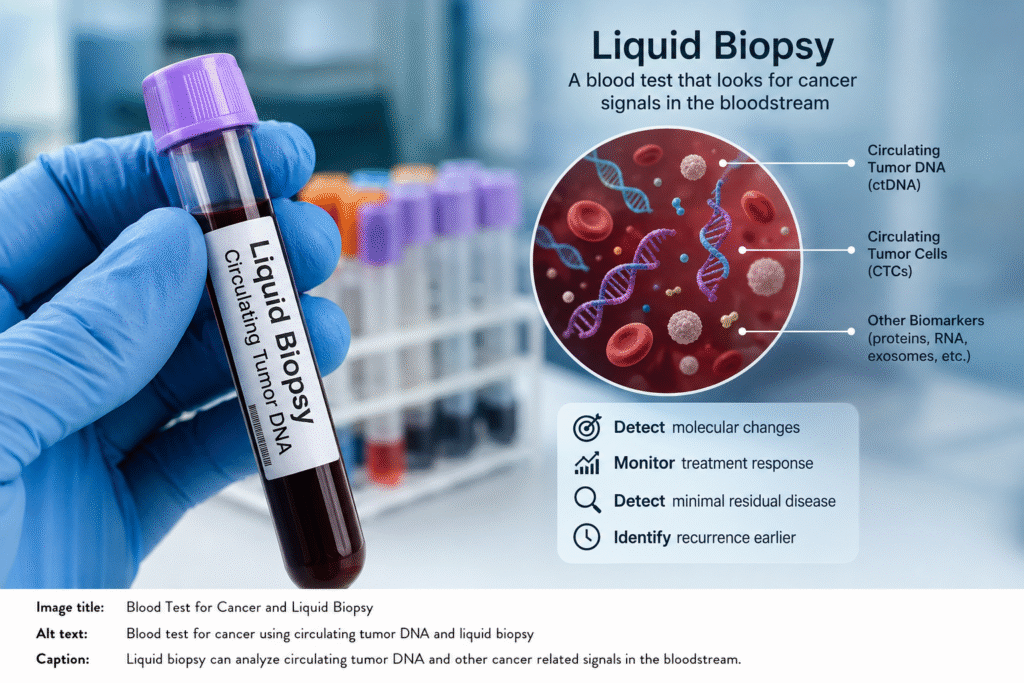
Cancer is not simply a mass that appears on a scan. Cancer cells undergo genetic and molecular changes and may release measurable material into the circulation. Modern laboratory techniques can detect some of these signals at extremely low concentrations. This has created an expanding field known as liquid biopsy. The National Cancer Institute defines liquid biopsy broadly as the detection of circulating tumor cells, circulating tumor DNA, exosomes, and other cancer related analytes in blood or other body fluids.
How a Blood Test Can Detect Cancer
A traditional tissue biopsy removes cells directly from a tumor. A pathologist then examines those cells to determine whether cancer is present and what type of cancer it is.
A liquid biopsy approaches the problem differently. Instead of removing tissue from the tumor, a blood sample is examined for biological material that the cancer has released into circulation.
One of the most important substances is circulating tumor DNA, usually called ctDNA.
Normal cells continuously release small fragments of DNA into the bloodstream. Cancer cells can do the same. The fraction originating from malignant cells is called circulating tumor DNA.
Advanced laboratory techniques can examine ctDNA for mutations, amplifications, deletions, methylation patterns, and other molecular abnormalities. This can sometimes reveal important information about the biology of a patient’s cancer without another invasive tissue biopsy.
Circulating Tumor DNA
Circulating tumor DNA is not an entire cancer cell. It consists of fragments of DNA released from malignant cells.
This distinction is important because ctDNA can contain some of the same molecular abnormalities found within the tumor.
For a patient who already has cancer, testing may sometimes identify molecular alterations that can influence treatment selection. Depending upon the cancer, these might include abnormalities involving genes such as EGFR, KRAS, BRAF, BRCA1, BRCA2, ESR1, PIK3CA, or other molecular pathways.
This is one of the reasons liquid biopsy has become important in precision oncology. It may provide information about what is driving the cancer rather than simply identifying the organ in which the cancer began.
However, a liquid biopsy does not necessarily identify every abnormality present in a tumor. The amount of tumor DNA in blood varies greatly between patients and between different cancers.
Circulating Tumor Cells
Circulating tumor cells, commonly called CTCs, are different from circulating tumor DNA.
CTCs are actual malignant cells that have separated from a primary or metastatic tumor and entered the bloodstream.
Researchers have studied circulating tumor cells for many years because their number and characteristics may provide information about tumor biology, prognosis, metastasis, and response to treatment.
The difficulty is that these cells can be extremely rare. A blood sample can contain enormous numbers of normal blood cells and only a very small number of circulating malignant cells.
For this reason, specialized laboratory techniques are required to isolate and analyze them.
CTC testing and ctDNA testing therefore examine two different manifestations of cancer circulating within the blood. Modern liquid biopsy research may also examine RNA, proteins, exosomes, and other tumor derived material.
Can A Blood Test Detect Cancer Before a Scan?
Can a blood test detect cancer early? Sometimes it can.
This is one of the most important potential advantages of molecular blood testing.
CT, MRI, PET, and other imaging technologies require a sufficient amount of abnormal tissue before a lesion can be visualized reliably. Microscopic numbers of malignant cells can exist below the detection limits of conventional imaging.
Highly sensitive ctDNA testing may sometimes detect molecular evidence of cancer when there is no measurable tumor visible on a scan.
This does not mean that blood testing is universally more accurate than imaging. The two methods measure completely different things.
Imaging identifies structural or functional abnormalities in the body.
ctDNA identifies molecular material released from malignant cells.
The two technologies can therefore complement rather than replace each other.
Minimal Residual Disease
One of the most promising applications of a blood test for cancer is the detection of molecular residual disease.
Consider a patient who undergoes surgery intended to remove all visible cancer.
After surgery, a CT or PET scan may show no evidence of disease. That is reassuring, but a scan cannot demonstrate that every malignant cell has been eliminated.
Microscopic cancer cells may remain below the limits of imaging.
If tumor specific DNA can still be detected in the bloodstream after treatment, this is called molecular residual disease, or MRD.
The presence of postoperative ctDNA has been associated with a substantially increased risk of recurrence in several solid tumors, particularly colorectal cancer. Large prospective studies continue to evaluate how this information should be incorporated into treatment decisions.
What We Learned From Colon Cancer
Colon cancer has provided some of the strongest evidence supporting ctDNA directed treatment.
The DYNAMIC trial examined patients with stage II colon cancer after surgery.
Investigators compared conventional decisions about postoperative chemotherapy with a strategy that used ctDNA results to help determine who should receive chemotherapy.
The ctDNA guided approach resulted in fewer patients receiving adjuvant chemotherapy without compromising recurrence free survival.
This was an important development.
It demonstrated that ctDNA could potentially move beyond simply predicting prognosis and begin helping physicians make actual treatment decisions.
More recent large prospective colorectal cancer studies have strengthened the relationship between postoperative ctDNA positivity and recurrence risk. In the 2024 CIRCULATE Japan GALAXY analysis, molecular residual disease detected by ctDNA was strongly associated with disease free and overall survival.
This does not mean that every patient with colon cancer should have exactly the same testing strategy. The clinical usefulness of ctDNA depends upon the disease, stage, timing of testing, assay, and treatment situation.
Monitoring Whether Treatment Is Working
A blood test for cancer may also help physicians determine whether treatment is controlling the disease.
If measurable ctDNA is present before treatment, repeated measurements during therapy may reveal whether the amount of circulating tumor DNA is falling, remaining stable, or increasing.
A substantial decline can be associated with treatment response.
Persistent or increasing ctDNA may suggest residual disease, resistance, or progression.
This approach is attractive because blood can be sampled repeatedly. Repeated tissue biopsies are considerably more invasive and may be impractical.
The concept is sometimes described as obtaining molecular snapshots of the cancer over time.
Cancer evolves. The molecular profile found at diagnosis may not remain identical several years later after exposure to chemotherapy, hormone therapy, targeted drugs, or immunotherapy.
Liquid biopsy may therefore sometimes identify emerging resistance mechanisms that were not apparent in the original tumor.
Can a blood test detect cancer recurrence? For a more detailed discussion of surveillance after treatment, read Monitoring Cancer and Detecting Recurrence on this website.
Tumor Markers Are Also Blood Tests
Blood tests have been used in oncology for decades.
Traditional tumor markers include PSA in prostate cancer, CEA in colorectal cancer, CA 125 in ovarian cancer, CA 19 9 in pancreatic and biliary cancers, and other markers used in selected situations.
Tumor markers can be useful, particularly when changes are followed over time.
However, they are not perfect cancer detection tests.
Some cancers do not produce substantial amounts of these markers.
Some noncancerous conditions can cause elevated results.
A normal tumor marker does not necessarily mean cancer is absent.
An elevated tumor marker does not by itself prove that cancer is present.
Modern liquid biopsy differs because investigators are attempting to detect tumor derived molecular material rather than relying solely upon proteins associated with cancer.
Can One Blood Test Screen for Many Cancers?
This is one of the most interesting areas of cancer research.
Multi cancer detection tests, sometimes called MCD tests, are designed to examine one blood sample for molecular signals associated with several different cancers.
Some analyze abnormal DNA methylation patterns.
Others examine mutations, proteins, fragments of DNA, or combinations of biomarkers.
Computer algorithms and artificial intelligence may then analyze these patterns and estimate whether a cancer signal exists and sometimes predict where the cancer originated.
The National Cancer Institute describes MCD tests as blood based assays that measure substances shed by cancer, including tumor DNA and circulating tumor cells. However, these tests remain under active study, particularly because the critical question is not simply whether they detect more cancers, but whether using them for population screening ultimately reduces deaths without causing excessive harm from false positive findings and unnecessary procedures.
Why a Blood Test for Cancer Can Miss Disease
This limitation must be understood.
A tumor must release enough detectable material into the circulation for a liquid biopsy to find it.
Some tumors shed substantial quantities of DNA.
Others shed very little.
Small early cancers may release such tiny quantities that the concentration falls below the sensitivity of the assay.
Anatomical location also matters.
This means a negative liquid biopsy does not establish that a patient is cancer free.
The National Cancer Institute has specifically identified the small amount of ctDNA present in some blood samples as a major limitation to cancer detection using liquid biopsy. Researchers are actively investigating methods to improve sensitivity.
This limitation becomes especially important when a patient already has a suspicious mass, abnormal imaging, unexplained symptoms, or another compelling reason for further diagnostic evaluation.
A negative blood test should not be used to dismiss convincing clinical evidence of possible cancer.
Why Tissue Biopsy Is Still Important
Liquid biopsy has not eliminated the need for conventional biopsy.
For most solid tumors, tissue remains the foundation of diagnosis.
A pathologist can examine the architecture of the tumor and determine exactly what type of malignant cells are present.
Tissue can establish histologic type and grade.
Immunohistochemistry can evaluate receptors and proteins.
Molecular testing can then examine DNA and RNA within the tumor itself.
A blood test for cancer can provide additional biological information, but it frequently cannot provide everything obtained from tissue.
There are circumstances where liquid biopsy is particularly useful. A tumor may be difficult or dangerous to biopsy. There may not be enough tissue available for comprehensive genomic analysis. A physician may also want updated molecular information after the cancer has progressed.
In these situations, blood based molecular profiling can be extremely valuable.
But tissue biopsy and liquid biopsy should usually be viewed as complementary technologies rather than competitors.
Screening, Diagnosis and Monitoring Are Different
Patients should understand that blood testing for cancer can have several very different purposes.
Screening means looking for cancer in someone who has no known cancer.
Diagnosis means determining whether a suspicious abnormality actually represents malignancy.
Molecular profiling means looking for biological abnormalities within an already diagnosed cancer.
Monitoring means following a known cancer during treatment.
Surveillance means looking for evidence that cancer has returned after treatment.
The evidence supporting blood testing is different for each of these purposes.
ctDNA testing already has established uses for molecular profiling in selected advanced cancers and increasingly important applications in treatment monitoring and residual disease research.
Using a single blood test to screen healthy people for many cancers simultaneously is promising but remains an evolving area.
The National Cancer Institute’s Vanguard Study is enrolling up to 24,000 people as part of the effort to determine how multi cancer detection testing should be evaluated in larger randomized trials and whether the benefits ultimately outweigh the harms.
A Positive Blood Test Does Not Automatically Mean Cancer
This is another important limitation.
A positive screening blood test may indicate that additional investigation is necessary.
It does not necessarily establish a cancer diagnosis.
Follow up may require CT, MRI, ultrasound, mammography, endoscopy, PET imaging, repeat laboratory testing, or tissue biopsy depending upon the suspected cancer.
False positive results matter because they can expose patients to anxiety, additional imaging, invasive procedures, expense, and sometimes unnecessary biopsies.
False negative results matter because they can provide inappropriate reassurance.
This is why the value of any cancer screening test must ultimately be judged by whether using it improves meaningful patient outcomes, not simply by whether it detects molecular abnormalities.
The Future of Cancer Blood Testing
The future will probably not involve choosing between blood testing, imaging, pathology, and molecular testing.
The more likely future is integration.
Imaging tells physicians where abnormal disease may be located.
Pathology identifies what the cancer is.
Genomic and molecular testing may reveal what biological abnormalities are driving it.
Liquid biopsy may help show how those abnormalities change over time.
ctDNA may help identify microscopic residual disease.
Artificial intelligence may increasingly integrate these different sources of information.
The goal is a more complete understanding of an individual patient’s cancer.
Conclusion
Can a blood test detect cancer?
Sometimes it can, and the technology is improving rapidly.
A blood test for cancer can sometimes identify circulating tumor DNA, circulating tumor cells, molecular abnormalities, and other cancer related biological signals.
It may help identify actionable mutations.
It may help monitor whether treatment is working.
It may help detect molecular residual disease after surgery.
It may sometimes provide evidence of recurrence before disease becomes visible on conventional imaging.
Emerging multi cancer detection tests may eventually create additional approaches to cancer screening.
But these tests also have important limitations.
Some tumors release very little detectable material into the blood.
Negative results do not guarantee that cancer is absent.
Positive screening results require further investigation.
And for most newly diagnosed solid tumors, tissue biopsy remains critically important.
The greatest value of blood based cancer testing is therefore not that it replaces every other test. Its value is that it provides another source of biological information that can be combined with pathology, imaging, molecular testing, and clinical judgment to make cancer care increasingly precise.
For additional patient information, visit the National Cancer Institute’s Questions and Answers About Multi Cancer Detection Tests.
Educational Disclaimer
This information is provided for educational purposes only. It does not constitute medical advice, diagnosis, treatment, or prescribing. Cancer screening, diagnostic testing, molecular testing, and surveillance must be individualized according to the patient’s symptoms, risk factors, pathology, imaging, medical history, treatment history, and current medical guidelines. Patients should discuss cancer testing and treatment decisions with their treating physicians and oncology team. This information does not establish a physician patient relationship.
References
- Wan JCM, Massie C, Garcia Corbacho J, et al. Liquid biopsies come of age: towards implementation of circulating tumour DNA. Nature Reviews Cancer. 2017;17:223 to 238.
- Siravegna G, Marsoni S, Siena S, Bardelli A. Integrating liquid biopsies into the management of cancer. Nature Reviews Clinical Oncology. 2017;14:531 to 548.
- Merker JD, Oxnard GR, Compton C, et al. Circulating Tumor DNA Analysis in Patients With Cancer: American Society of Clinical Oncology and College of American Pathologists Joint Review. Journal of Clinical Oncology. 2018;36:1631 to 1641.
- Tie J, Cohen JD, Lahouel K, et al. Circulating Tumor DNA Analysis Guiding Adjuvant Therapy in Stage II Colon Cancer. New England Journal of Medicine. 2022;386:2261 to 2272.
- Kotani D, Oki E, Nakamura Y, et al. Molecular residual disease and efficacy of adjuvant chemotherapy in patients with colorectal cancer. Nature Medicine. 2023;29:127 to 134.
- Nakamura Y, et al. ctDNA based molecular residual disease and survival in resectable colorectal cancer. Nature Medicine. 2024.
- Faulkner LG, Howells LM, Pepper C, et al. The utility of ctDNA in detecting minimal residual disease following curative surgery in colorectal cancer: a systematic review and meta analysis. British Journal of Cancer. 2023.
- National Cancer Institute. Liquid Biopsy Consortium. Division of Cancer Prevention.
- National Cancer Institute. Questions and Answers About Multi Cancer Detection Tests. Division of Cancer Prevention.
- National Cancer Institute. Vanguard Study. Cancer Screening Research Network.
- National Cancer Institute. Increasing ctDNA Volume to Improve Liquid Biopsy Cancer Detection. NCI Cancer Currents. February 22, 2024.
- Kim H, et al. Clinical Circulating Tumor DNA Testing for Precision Oncology. Cancer Research and Treatment. 2023.