A multi-cancer early detection test is designed to look for signals from many different cancers from a single blood draw. The concept addresses an important problem in cancer screening. We have established screening programs for only a limited number of cancers, while cancers such as pancreatic, ovarian, liver, and esophageal cancer frequently have no routine population screening test and may not be discovered until they are advanced.
The idea is compelling. Draw blood from someone without cancer symptoms, identify a molecular signal suggesting cancer is present, and ideally determine where that signal originated.
But the science in 2026 requires a careful explanation.
A multi cancer early detection test can potentially identify cancers that conventional screening would miss. It can also miss cancers that are actually present. A positive result does not prove that cancer is present, and a negative result does not prove that cancer is absent.
The first randomized trial of this approach has now reported results. Those results are promising, but they also demonstrate why these tests should not yet be considered replacements for conventional cancer screening.
Early detection is only the first step. Once cancer is identified, the next decisions involve diagnosis, staging, molecular testing, and appropriate cancer treatment approaches.
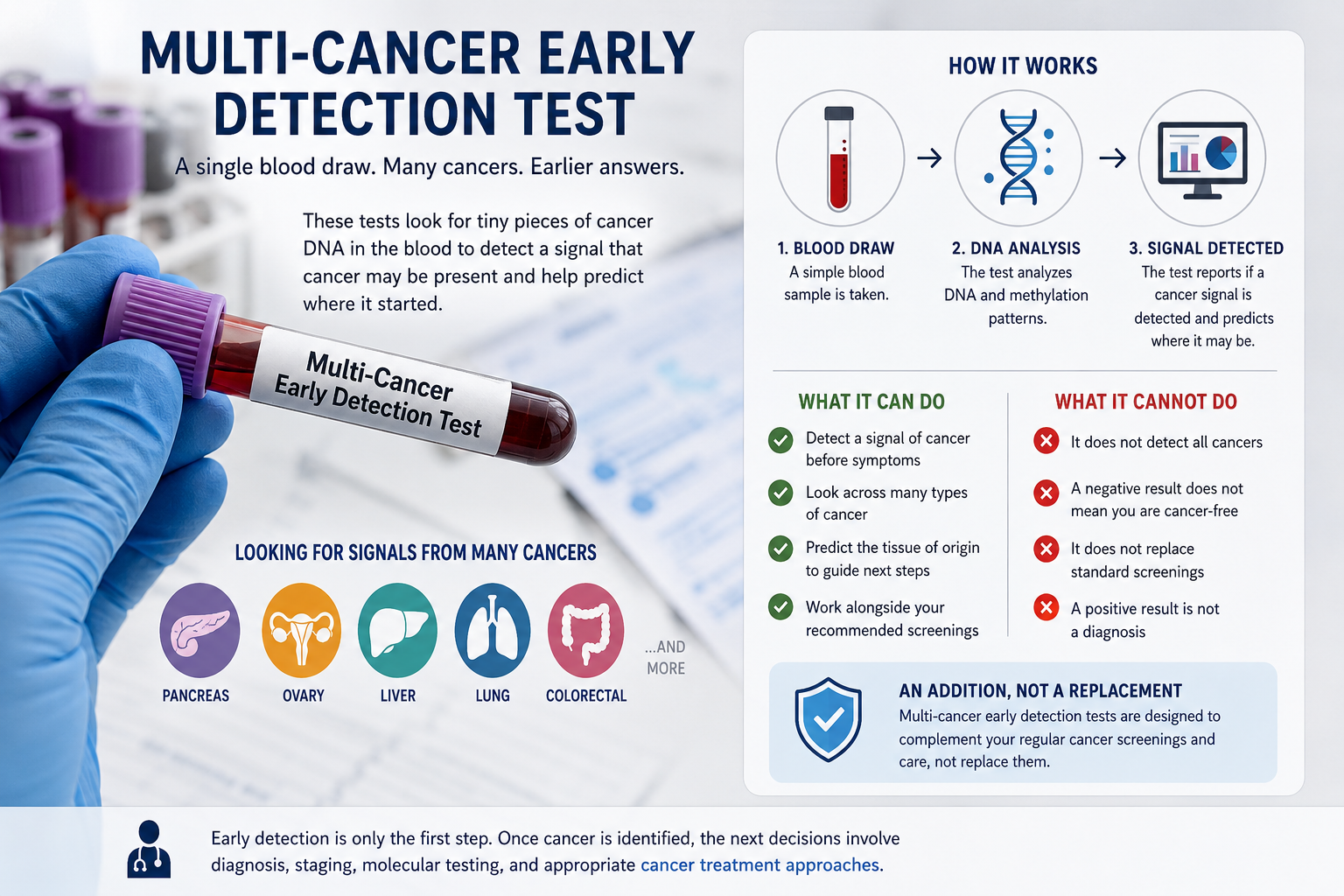
How a Multi Cancer Early Detection Test Works
Every day, normal cells die and release small fragments of DNA into the bloodstream.
Cancer cells can do the same.
These fragments are part of what is called cell free DNA. When DNA originates from cancer cells, molecular characteristics within that DNA may provide clues that malignant cells are present.
Many multi cancer early detection tests rely heavily on DNA methylation patterns rather than simply looking for individual mutations. Methylation consists of chemical modifications associated with regulation of gene activity. These patterns can differ between normal and malignant cells and can also contain information about the tissue from which the DNA originated.
This is important because a useful screening test must ideally answer two questions.
Is there evidence of cancer?
And if there is, where should the physician look?
NCI describes multi cancer detection tests as blood tests being studied to identify biomarkers released by cancers and potentially detect multiple cancers at once. No multi cancer detection test was FDA approved as of the latest NCI information available in August 2026.
Multi Cancer Early Detection Test Versus Liquid Biopsy
These concepts are related but should not be confused.
A diagnostic liquid biopsy is commonly considered after a patient already has known or suspected cancer. It may look for tumor DNA alterations that can help characterize the cancer molecularly.
A multi cancer early detection test has a different purpose.
It is intended to screen someone who does not have symptoms or a known cancer diagnosis for evidence that cancer may be present.
Multi Cancer Early Detection Test Results From NHS Galleri
The NHS Galleri trial is extremely important because it is the first randomized controlled trial of a multi cancer early detection test to report results.
Nearly 143,000 adults between ages 50 and 77 were enrolled in England. Participants received conventional recommended screening, and approximately half also had annual Galleri testing for three years.
The trial asked a crucial question.
Could adding Galleri reduce the number of cancers diagnosed at stages III and IV?
The answer was not definitively yes.
The study did not meet its predefined primary endpoint of significantly reducing combined stage III and IV cancer diagnoses.
That finding is important and should not be minimized.
But several secondary findings were encouraging.
Among 12 prespecified cancers, the Galleri group had fewer stage IV cancers and more cancers diagnosed before stage IV. Across all cancer types, approximately four times as many cancers were detected through screening in the Galleri group as through recommended screening alone. Emergency presentations also decreased by approximately 20 percent.
These findings suggest that a multi cancer early detection test may be able to shift some cancers toward an earlier time of diagnosis.
Whether that ultimately means fewer cancer deaths remains unanswered.
How Accurate Was the Galleri Test?
Several numbers from the NHS Galleri trial are particularly important.
Specificity was 99.55 percent.
That means the test was very good at correctly identifying people who did not have a cancer signal.
The positive predictive value was approximately 52 percent.
In practical terms, when Galleri produced a positive cancer signal, approximately half of those individuals were ultimately found to have cancer.
When Galleri predicted one site of cancer origin, that prediction was correct in approximately 87 percent of participants who were ultimately found to have cancer. When its top two predicted sites were considered, accuracy increased to approximately 92.5 percent.
Those are impressive localization figures.
But they do not tell us how many cancers the test misses.
That is a different measure called sensitivity.
What a Negative Multi Cancer Early Detection Test Means
This may be the most important section of the entire article.
A negative multi cancer early detection test does not mean that you do not have cancer.
Cancer DNA must enter the bloodstream in sufficient quantity for a blood based test to detect it.
Very small tumors may shed little DNA.
Some cancers shed more DNA than others.
Tumors with poor vascular access may release relatively little material into circulation.
For these reasons, a cancer can be biologically present while the blood test remains negative.
This is why a multi cancer early detection test must not replace recommended cancer screening.
A negative Galleri result is not a reason to skip a mammogram.
It is not a reason to cancel a colonoscopy.
It does not replace cervical cancer screening.
It does not replace low dose CT lung screening in patients who meet established criteria.
GRAIL itself states that Galleri should be used in addition to routine cancer screening rather than as a replacement. NCI likewise describes these tests as potential additions to established screening.
Why a Multi Cancer Early Detection Test Can Miss Early Cancer
There is an apparent paradox.
We want these tests primarily because we want to find cancer early.
But the smallest cancers can be among the hardest cancers for a blood test to detect.
A stage I tumor may contain far fewer malignant cells than a stage IV tumor.
It may therefore release far less circulating tumor DNA.
This creates one of the central scientific challenges in multi cancer screening.
Improving sensitivity without generating an unacceptable number of false positives will be critical to the future of the field.
What Happens After a Positive Result?
A positive multi cancer early detection test is not a diagnosis of cancer.
It begins a diagnostic investigation.
The report may indicate that a cancer signal was detected and provide a predicted site of origin.
The physician can then direct imaging or another diagnostic evaluation toward that organ.
If imaging finds a suspicious lesion, a biopsy may be necessary to establish the diagnosis.
The positive predictive value of approximately 52 percent deserves careful thought.
It means that roughly half of positive results in the NHS Galleri trial were associated with a diagnosed cancer and roughly half were not.
For someone in the second group, the consequences can include imaging, specialist consultations, possible invasive procedures, cost, and substantial anxiety while determining whether cancer is actually present.
The NHS Galleri investigators reported short term anxiety after positive tests and burdens associated with follow up testing.
That is not an argument against testing.
It is information a patient should understand before testing.
What PATHFINDER 2 Added in 2026
The PATHFINDER 2 study provides additional prospective North American evidence.
The full 2026 analysis included 35,878 participants, which is larger than the earlier interim cohort referenced in some reports.
GRAIL reported that adding Galleri to standard recommended screening increased cancer detection approximately 6.5 fold, and 71 percent of newly detected cancers identified by Galleri were stages I through III.
This is encouraging evidence about detection performance.
However, PATHFINDER 2 was not a randomized trial designed to prove that MCED screening reduces cancer mortality.
That distinction remains essential.
Detecting more cancer is not automatically equivalent to saving more lives.
Does Earlier Detection Mean Longer Survival?
Not necessarily.
This is one of the most important lessons in the history of cancer screening.
A screening test may detect cancer earlier and appear to increase survival measured from the date of diagnosis without actually delaying death. This phenomenon is known as lead time bias.
Screening can also find slow growing cancers that might never have caused illness during the patient’s lifetime. That is called overdiagnosis.
The ultimate question is therefore not simply:
Does a multi cancer early detection test find more cancers?
The ultimate question is:
Does using the test reduce deaths from cancer without causing excessive harm from false positives and overdiagnosis?
That question has not yet been answered.
ASCO specifically noted after the 2026 NHS Galleri results that longer follow up is required to determine whether the observed shift in stage actually translates into improved survival.
Where Multi Cancer Early Detection Tests Stand in 2026
Regulatory status is important.
Galleri is commercially available in the United States as a laboratory developed test, but commercial availability should not be confused with FDA approval.
GRAIL submitted a premarket approval application to the FDA in January 2026, and the application was accepted for review. As of August 2026, NCI continued to state that no multi cancer detection test had been FDA approved. You can visit the National Cancer Institute’s screening information.
This distinction matters because patients sometimes assume that availability means the test has passed the same FDA review process as an approved screening test.
It has not yet done so.
Who Might Consider a Multi Cancer Early Detection Test?
There is no single answer for everyone.
The evidence is strongest in populations similar to those actually studied, particularly adults aged 50 and older.
Age matters because cancer incidence rises substantially with age, increasing the probability that screening will identify clinically significant disease.
Another potential consideration is concern about cancers for which conventional population screening does not exist.
Pancreatic and ovarian cancer are obvious examples.
Personal and family cancer history may also influence how a physician and patient view the potential benefits and limitations of additional screening.
But before ordering the test, ask yourself another question.
If this result is positive, am I willing to undergo the diagnostic workup that follows?
If the answer is no, the value of screening becomes considerably less clear.
Frequently Asked Questions
Does a Multi Cancer Early Detection Test Replace a Colonoscopy?
No.
A multi cancer early detection test should not replace colonoscopy or other recommended colorectal cancer screening.
A negative blood test does not exclude colorectal cancer or advanced precancerous polyps.
Continue your established screening schedule unless your physician recommends otherwise.
Can a Multi Cancer Early Detection Test Find Pancreatic Cancer?
Potentially.
One of the major attractions of MCED technology is its ability to look for cancers that currently lack routine population screening programs, including pancreatic cancer.
But not every pancreatic cancer will release enough detectable signal to produce a positive test.
Therefore, a negative result cannot exclude pancreatic cancer.
What Does a Positive Galleri Result Mean?
It means a cancer associated molecular signal was detected.
It does not prove that you have cancer.
Further diagnostic evaluation is required.
In the NHS Galleri trial, positive predictive value was approximately 52 percent.
What Does a Negative Galleri Result Mean?
It means the assay did not identify a cancer signal above its detection threshold.
It does not mean cancer is impossible.
Continue all age appropriate and risk appropriate conventional screening.
Is Galleri FDA Approved?
As of August 2026, no.
GRAIL has submitted Galleri for FDA premarket approval, but NCI continues to list MCED tests as not FDA approved.
The Bottom Line
A multi cancer early detection test represents one of the most interesting developments in modern cancer screening.
One blood draw can potentially identify molecular evidence of numerous cancers, including some cancers for which we currently have no routine screening test.
The first randomized trial has now produced evidence that Galleri can increase cancer detection and may reduce the number of cancers first diagnosed at stage IV.
But the same trial did not meet its primary endpoint of significantly reducing combined stage III and IV diagnoses.
And the most important question remains unanswered.
Does multi cancer early detection actually reduce cancer mortality?
We do not yet know.
For now, these tests should be viewed as potential additions to established cancer screening, not substitutes for it.
That is the balance patients need to understand.
By Dean R. Silver, MD, MD (H)
Educational Disclaimer
This article is provided for cancer education only. It is not medical advice and does not establish a physician patient relationship. Immunotherapy biomarkers should not be interpreted independently to determine whether you should start, stop, or change cancer treatment. PD-L1, MSI, mismatch repair, TMB, and other molecular findings must be interpreted in the context of your cancer type, stage, pathology, prior treatments, overall molecular profile, medical condition, and current treatment guidelines. Treatment decisions should be discussed with your treating oncologist.