By Dean R. Silver, MD, MD(H)
Tissue biopsy vs liquid biopsy is not really a question of which test is universally better. These tests measure overlapping yet distinct aspects of cancer, and in many patients, they are most useful when interpreted together.
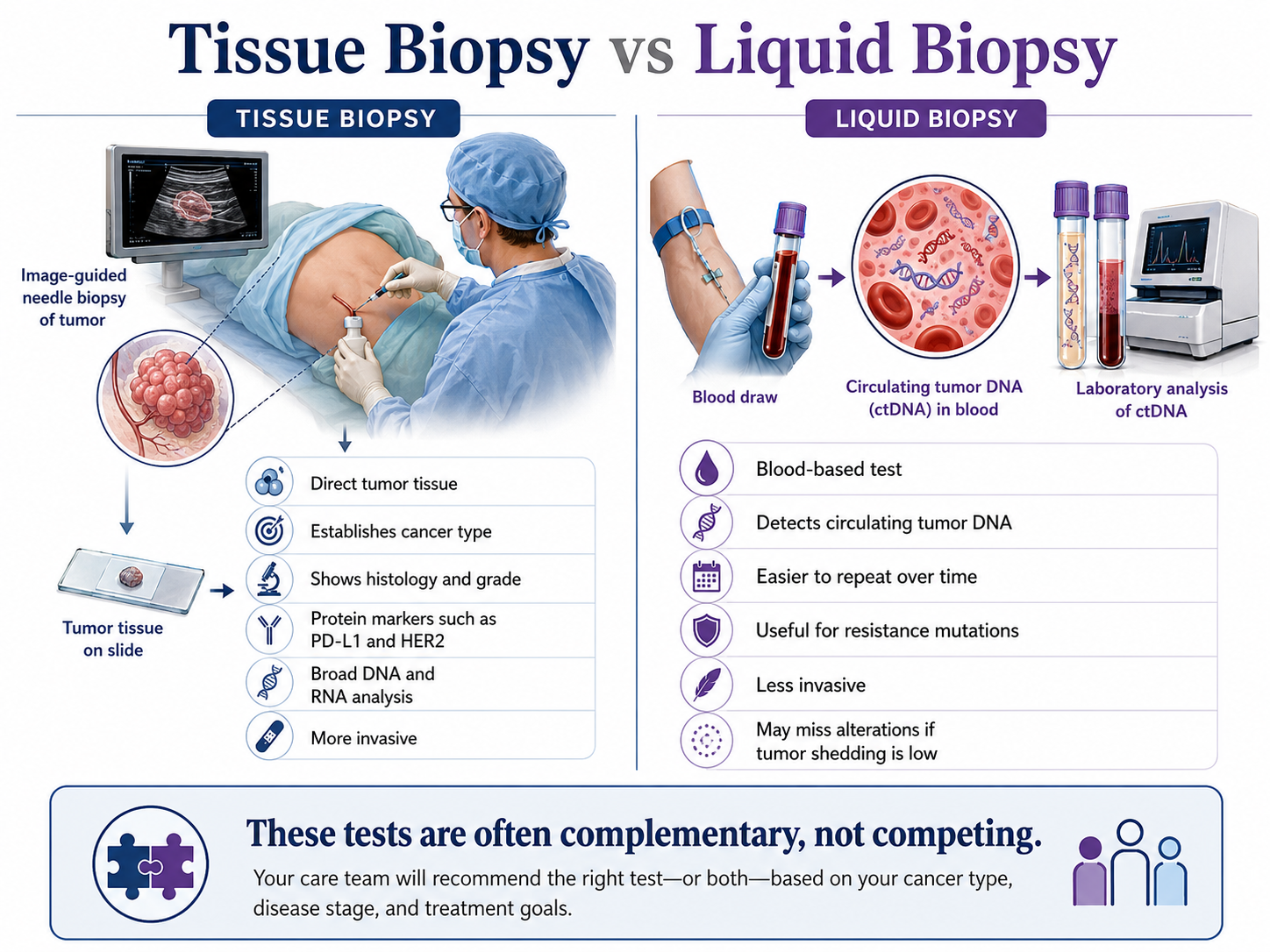
A tissue biopsy examines actual tumor cells and tissue architecture. A liquid biopsy usually analyzes circulating tumor DNA, or ctDNA, released into the bloodstream. Tissue can establish histology, grade, many protein biomarkers, and detailed molecular features. Blood testing can provide genomic information without another invasive procedure and may capture alterations arising from more than one tumor site.
The better question is often not “Which test should I choose?” but rather “What information do I need, and which test is most likely to provide it?”
Tissue Biopsy vs Liquid Biopsy at a Glance
Tissue biopsy provides actual tumor tissue. It is generally the preferred method for establishing the histologic diagnosis, determining tumor architecture, and performing immunohistochemistry.
Liquid biopsy uses blood, most commonly to analyze circulating tumor DNA. It can identify many genomic alterations and can be repeated more easily over time.
Tissue is generally stronger for histology, protein expression, and broad RNA-based profiling.
Blood is generally stronger for convenience, repeat testing, and detecting genomic alterations when tissue is unavailable or difficult to obtain.
Neither test completely replaces the other.
What Tissue Biopsy Does Better
Tissue Establishes What the Cancer Is
One of the greatest strengths of tissue biopsy is that a pathologist can directly examine the tumor under a microscope.
This allows determination of cancer type, differentiation, architecture, and often grade.
For example, the distinction between adenocarcinoma, squamous carcinoma, lymphoma, sarcoma, and other tumor types depends heavily on tissue morphology and immunohistochemistry.
A blood-based genomic test generally cannot replace this information.
Tissue Provides Protein Biomarkers
Many cancer treatment decisions still depend upon protein expression measured directly in tumor tissue.
Examples include PD-L1 immunohistochemistry, HER2 expression in several cancers, estrogen and progesterone receptor status in breast cancer, and other protein-based biomarkers.
These findings often influence treatment selection and cannot always be inferred reliably from circulating DNA alone.
Tissue Supports Broad DNA and RNA Profiling
Tissue can support large genomic panels, whole exome sequencing, RNA sequencing, fusion analysis, copy number analysis, and immunohistochemistry.
This is especially valuable when the clinical question extends beyond a small number of common mutations.
The broader role of tissue-based molecular testing is discussed in the article on comprehensive tumor profiling.
Internal link: Highlight comprehensive tumor profiling and link it to your comprehensive profiling article.
Tissue Does Not Depend on Tumor DNA Shedding
Liquid biopsy depends upon tumor DNA reaching the bloodstream.
Some cancers shed large amounts of ctDNA. Others shed very little.
Tissue testing does not have this specific limitation, although tissue biopsy can fail if the sample is too small, contains too little viable tumor, or has been damaged by processing.
What Liquid Biopsy Does Better
Liquid Biopsy Is Less Invasive
A liquid biopsy usually requires only a standard blood draw.
That makes it much easier to perform in patients who are frail, anticoagulated, medically unstable, or have tumors in locations that are difficult or dangerous to biopsy.
This difference becomes particularly important when repeat testing is needed.
Liquid Biopsy Can Be Repeated Over Time
Cancer changes under treatment pressure.
Resistance mutations can emerge during targeted therapy, endocrine therapy, and other treatments.
Because blood testing can be repeated relatively easily, it can help detect new genomic alterations during the course of disease.
This makes liquid biopsy especially useful when the clinical question concerns tumor evolution rather than initial diagnosis.
Liquid Biopsy May Reflect More Than One Tumor Site
A tissue biopsy samples one physical location.
Circulating tumor DNA may be released from multiple cancer deposits into the bloodstream. This means a blood test can sometimes detect molecular heterogeneity that a biopsy from one lesion misses.
However, this should not be overstated.
Not every metastatic site sheds DNA equally into the circulation. A liquid biopsy therefore provides a composite signal from shedding tumors, not a perfect molecular map of every lesion in the body.
Liquid Biopsy Can Help When Tissue Is Limited
Sometimes the tissue block has been exhausted.
Sometimes a biopsy contains too little tumor.
Sometimes the only available tissue is old or heavily decalcified.
In these situations, plasma-based genomic testing can provide important additional information without requiring another invasive procedure.
Tumor Shedding Is the Hidden Variable
This is one of the most important limitations of liquid biopsy.
A negative blood test does not always mean the tumor lacks genomic abnormalities.
It may simply mean that too little tumor DNA entered the bloodstream to be detected.
Tumor shedding varies by cancer type, tumor burden, metastatic location, treatment status, and individual biology.
Large-volume metastatic disease often produces more circulating tumor DNA than small-volume disease. Some brain tumors, low-volume cancers, and certain peritoneal-predominant malignancies may produce lower plasma ctDNA levels.
This is why the context of a negative result matters.
If the report shows measurable tumor fraction and no actionable alteration, that result may be more informative than a report in which little or no tumor-derived DNA was detected.
Why Tissue Biopsy vs Liquid Biopsy Is Often the Wrong Question
These tests are better viewed as complementary.
The most appropriate strategy depends upon the clinical situation.
A positive liquid biopsy finding may sometimes be sufficient to guide treatment when the alteration is well validated and the clinical context is appropriate.
A negative liquid biopsy does not necessarily exclude a targetable alteration, particularly when tumor shedding is low.
If tissue is available and the answer would change management, tissue testing may still be necessary.
The reverse is also true.
A tissue biopsy may miss genomic heterogeneity because it samples only one location. In selected patients, liquid biopsy can detect alterations not found in the sampled lesion.
The strongest interpretation often comes from considering both sources of information together.
Professional guidance supports using plasma-based genomic testing and tissue testing as complementary approaches in appropriate patients
When Tissue Is Usually Most Important
Tissue is particularly important when:
A new cancer diagnosis must be established.
Histology or tumor grade is uncertain.
Protein biomarkers such as PD-L1, HER2, estrogen receptor, or progesterone receptor are needed.
Broad RNA sequencing or fusion analysis is clinically important.
The blood test is negative or uninformative despite strong suspicion of a targetable alteration.
When Liquid Biopsy Can Be Especially Useful
Liquid biopsy can be especially valuable when:
Tumor tissue is unavailable or unsafe to obtain.
Rapid genomic information is needed.
The cancer has progressed after targeted therapy.
Resistance mutations are being investigated.
Repeated molecular testing is clinically useful.
The disease is metastatic and genomic heterogeneity is a concern.
Using Tissue and Blood Together
For many patients with advanced solid tumors, one practical strategy is:
First, obtain tissue when needed to establish diagnosis and pathology.
Second, perform genomic profiling using tissue, blood, or both depending upon the cancer and clinical urgency.
Third, interpret the results together rather than assuming one automatically overrides the other.
Fourth, consider repeat blood-based testing later if the cancer progresses or develops treatment resistance.
The exact sequence depends upon the cancer type, available tissue, treatment history, and clinical question.
There is no single testing algorithm that applies to every malignancy.
Discordant Results Do Not Automatically Mean One Test Is Wrong
Tissue VS. liquid biopsy reports sometimes disagree.
This can happen because the samples were obtained at different times.
It can happen because the tumor evolved.
It can happen because one lesion contains an alteration that another lesion does not.
It can also occur because of low tumor shedding or because plasma sequencing detects alterations arising from clonal hematopoiesis rather than the cancer itself.
Clonal hematopoiesis is particularly important because mutations in blood-forming cells can sometimes appear in plasma sequencing and be mistaken for tumor-derived mutations if not interpreted carefully.
This is one reason molecular results should be reviewed in the context of the patient’s pathology and clinical history.
Can Liquid Biopsy Detect Minimal Residual Disease?
A different type of blood testing is increasingly being used to look for molecular residual disease, or MRD, after treatment.
These assays are designed to detect very small amounts of tumor-derived DNA after surgery or other potentially curative treatment.
This is not exactly the same as broad liquid biopsy used to identify treatment targets in advanced cancer.
MRD testing is an important and rapidly developing field, but its clinical usefulness varies substantially by cancer type and treatment setting.
Patients should ask whether the test being ordered is intended for genomic profiling, treatment selection, recurrence monitoring, or MRD detection because these are different purposes.
Which Test Gives the Better Answer?
There is no universal winner.
If the question is, “What kind of cancer is this?” tissue usually provides the better answer.
If the question is, “What resistance mutation has emerged after therapy?” blood may provide a faster and less invasive answer.
If the question is, “What are the broad molecular features of this cancer?” tissue and blood may provide complementary information.
If the blood test is negative and the cancer is known to be present, tissue may still reveal alterations that plasma testing missed.
The best test is therefore the one that answers the specific clinical question.
Questions to Ask Your Oncologist
Ask what question the test is intended to answer.
Ask whether tissue, blood, or both are appropriate.
Ask whether the liquid biopsy detected enough tumor DNA to make a negative result meaningful.
Ask whether RNA sequencing was included if gene fusions are clinically important.
Ask whether protein biomarkers still need to be measured on tissue.
Ask whether the results should be reviewed by a molecular tumor board.
The Most Important Point in Liquid Biopsy VS. Tissue Biopsy
Tissue biopsy and liquid biopsy are not competing technologies.
They are different windows into cancer biology.
Tissue shows us what the tumor looks like and what proteins and molecular abnormalities are present in a sampled lesion.
Liquid biopsy can reveal tumor-derived DNA circulating in the blood and can sometimes detect genomic changes across evolving metastatic disease.
Used thoughtfully, each can compensate for limitations of the other.
The goal is not to choose the newest test.
The goal is to obtain the information most likely to improve the treatment decision.
Educational Disclaimer
This article is provided for general cancer education only. It is not medical advice and does not establish a physician patient relationship. Tissue biopsy and liquid biopsy testing should be selected and interpreted by qualified medical professionals in the context of the patient’s diagnosis, pathology, stage, treatment history, tumor burden, and available treatment options.
References
- Merker JD, Oxnard GR, Compton C, et al. Circulating tumor DNA analysis in patients with cancer: American Society of Clinical Oncology and College of American Pathologists joint review. Journal of Clinical Oncology. 2018;36:1631-1641.
- Rolfo C, Mack PC, Scagliotti GV, et al. Liquid biopsy for advanced non-small cell lung cancer: a consensus statement from the International Association for the Study of Lung Cancer. Journal of Thoracic Oncology. 2021;16:1647-1662.
- Aggarwal C, Thompson JC, Black TA, et al. Clinical implications of plasma-based genotyping with the delivery of personalized therapy in metastatic non-small cell lung cancer. JAMA Oncology. 2019;5:173-180.
- Gerlinger M, Rowan AJ, Horswell S, et al. Intratumor heterogeneity and branched evolution revealed by multiregion sequencing. New England Journal of Medicine. 2012;366:883-892.
- Parikh AR, Leshchiner I, Elagina L, et al. Liquid versus tissue biopsy for detecting acquired resistance and tumor heterogeneity in gastrointestinal cancers. Nature Medicine. 2019;25:1415-1421.
- Razavi P, Li BT, Brown DN, et al. High-intensity sequencing reveals the sources of plasma circulating cell-free DNA variants. Nature Medicine. 2019;25:1928-1937.
- National Cancer Institute. Biomarker Testing for Cancer Treatment.
- National Comprehensive Cancer Network. Clinical Practice Guidelines in Oncology. Relevant disease-specific guidelines. 2026.