By Dr. Dean Silver, MD, MD (H)
ctDNA monitoring offers another source of information. For many patients, one of the hardest parts of cancer treatment is waiting between scans. Weeks or months may pass before imaging shows whether a treatment is working.
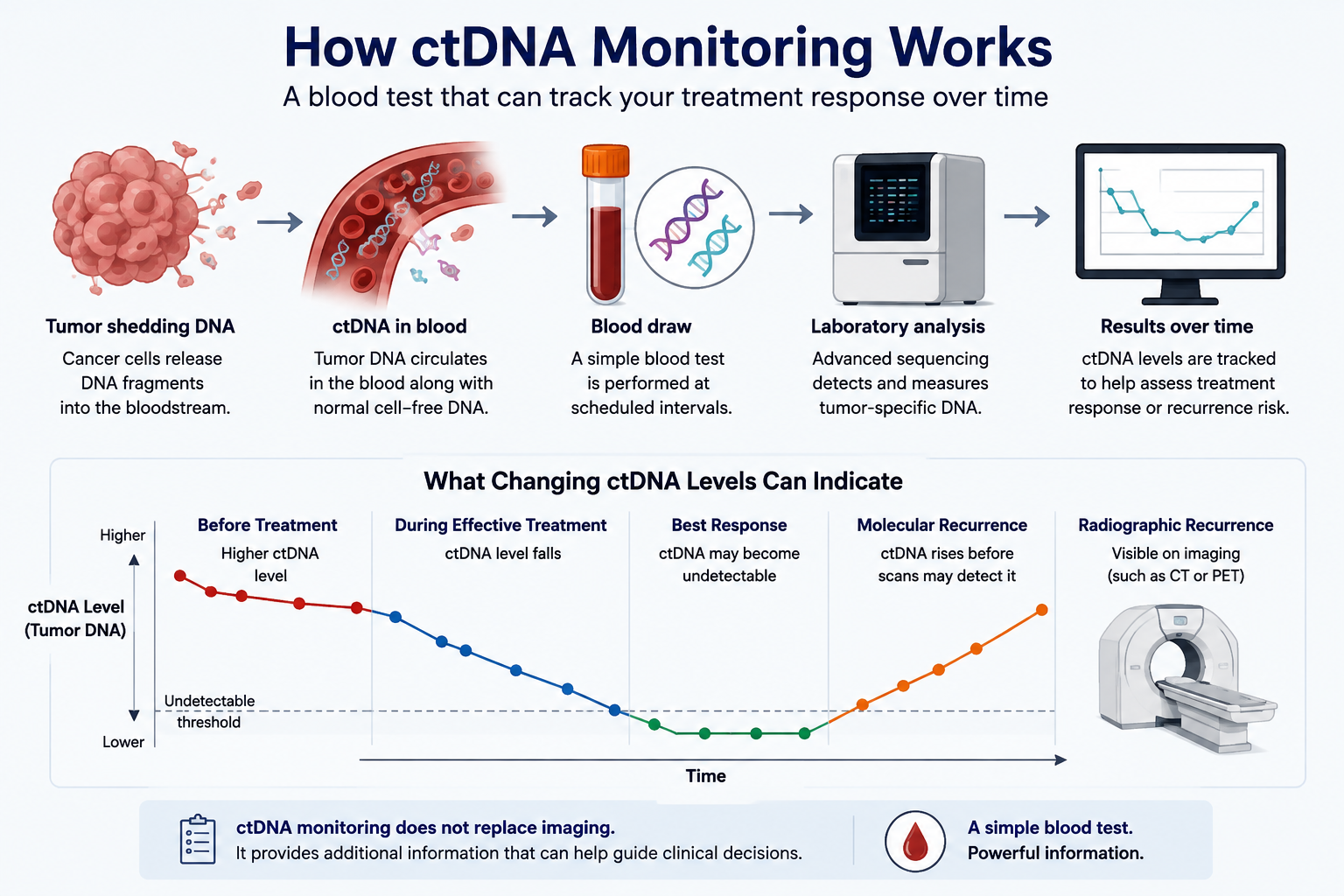
A blood test can measure circulating tumor DNA released by cancer cells and track whether that signal is rising, falling, or becoming undetectable over time. The National Cancer Institute notes that ctDNA can be used as a biomarker to help determine how well treatment is working or whether cancer has returned.
It is not a replacement for imaging. It does not answer every clinical question. But in selected cancers and treatment settings, serial ctDNA measurements can provide important information about response and recurrence risk.
The National Cancer Institute explains that circulating tumor DNA can be measured in blood and may help assess how well treatment is working or whether cancer has returned.
What Does ctDNA Monitoring Measure?
Circulating tumor DNA, or ctDNA, consists of small fragments of tumor-derived DNA found in the bloodstream. These fragments can contain molecular abnormalities originating from cancer cells.
The amount of detectable ctDNA often changes with disease burden and treatment response, although the relationship is not perfect and varies substantially by cancer type and tumor location.
There are two broad approaches to ctDNA testing.
ctDNA testing is one form of liquid biopsy for cancer, which can analyze tumor-derived genetic material circulating in the bloodstream.
Tumor-Informed Testing
A tumor-informed assay begins by analyzing an individual patient’s tumor tissue. The laboratory identifies tumor-specific alterations and then creates a personalized blood test designed to search for those particular abnormalities.
This approach can provide very high analytical sensitivity because the laboratory already knows which tumor-associated variants it is trying to detect.
Tumor-informed testing is commonly used in studies of molecular residual disease and recurrence surveillance.
Tumor-Naive or Tumor-Agnostic Testing
Other assays do not require sequencing the patient’s original tumor first.
Instead, they analyze a predefined collection of genomic or epigenomic abnormalities in the blood.
These tests can often be started more quickly, but performance varies according to the platform, cancer type, tumor burden, and specific purpose of the assay.
Why ctDNA Can Change Before a Scan
Imaging and ctDNA measure different aspects of cancer.
CT, MRI, and PET imaging primarily detect structural or metabolic abnormalities. Molecular testing measures tumor-derived material circulating in the blood.
Because these are different signals, molecular changes can sometimes occur before a corresponding change becomes apparent on imaging.
This is especially important after potentially curative treatment, when there may be no visible tumor remaining but microscopic cancer cells could still be present.
However, ctDNA should not be described as universally superior to imaging. Imaging remains essential because a blood test generally cannot tell the physician exactly where recurrent disease is located.
ctDNA Monitoring After Surgery and Molecular Residual Disease
One of the most promising applications of ctDNA is the detection of molecular residual disease, often abbreviated MRD.
After surgery intended to remove all visible cancer, standard imaging may show no remaining disease. The unresolved question is whether microscopic tumor cells remain.
A positive ctDNA result after surgery can identify patients at substantially increased risk of recurrence in several cancers.
One of the strongest datasets comes from colorectal cancer.
The updated CIRCULATE-Japan GALAXY analysis included 2,240 patients with resected colorectal cancer. Patients who were ctDNA-positive during the postoperative MRD period had markedly worse disease-free and overall survival than patients who were ctDNA-negative. In that study, ctDNA positivity during surveillance preceded radiologic recurrence by a median of approximately 5.9 months.
This is a powerful prognostic signal.
It does not automatically mean that every ctDNA-positive patient should immediately receive additional treatment. The crucial question is whether changing treatment solely because ctDNA became positive improves long-term survival. That question is still being addressed in prospective intervention trials.
What Have ctDNA in Breast Cancer Studies Shown?
Breast cancer research has also demonstrated that ctDNA can sometimes identify molecular recurrence before clinical or radiographic recurrence.
In a 2019 study using personalized ctDNA assays, tumor DNA was detected before clinical or radiologic metastatic relapse in 16 of 18 patients who eventually relapsed. The median lead time was 8.9 months, with some recurrences detected as much as two years earlier.
Longer-term postoperative research has reinforced the strong prognostic value of serial ctDNA monitoring in breast cancer.
These findings are important, but they should be interpreted carefully. Detecting relapse earlier does not by itself prove that treating at the molecular stage rather than waiting for radiographic disease improves overall survival.
That distinction is central to understanding this rapidly developing field.
What Does a Rising ctDNA Level Mean?
A rising ctDNA signal during serial testing may suggest that the cancer is becoming more active or that treatment control is weakening.
Depending upon the situation, it may reflect increasing tumor burden, emerging treatment resistance, or molecular progression before conventional imaging demonstrates clear progression.
A rising result should generally be treated as a signal requiring clinical interpretation rather than as an isolated diagnosis.
The oncologist may consider repeating the test, obtaining imaging earlier, reviewing the patient’s symptoms and laboratory data, or performing additional genomic testing if resistance alterations are suspected.
The meaning depends upon the cancer, treatment, assay, and overall clinical picture.
What Does Falling ctDNA Mean?
A falling ctDNA level during treatment can be encouraging.
Studies across several tumor types have shown associations between ctDNA decline or clearance and better treatment outcomes.
For example, recent research in metastatic invasive lobular breast cancer found that patients whose ctDNA decreased or remained stable during therapy were substantially more likely to show clinical benefit than patients whose ctDNA increased.
But again, ctDNA should be interpreted alongside imaging and clinical assessment.
A favorable molecular response is valuable information. It does not eliminate the need for conventional follow-up.
ctDNA Can Sometimes Help Interpret Difficult Scans
One potentially valuable use of serial molecular testing is when imaging is ambiguous.
After treatment, an abnormal area on imaging may represent active cancer, inflammation, necrosis, fibrosis, or other treatment-related changes.
This can be particularly complicated with immunotherapy because inflammatory immune responses can sometimes make scans difficult to interpret.
Changes in ctDNA may provide additional biological information in these circumstances.
However, ctDNA cannot reliably determine the anatomical location of disease. Imaging remains necessary.
What ctDNA Monitoring Cannot Tell You
It Usually Cannot Tell You Where the Cancer Is
A positive result indicates that tumor-derived DNA was detected in the bloodstream.
It generally does not identify the anatomical location responsible for that signal.
Imaging is still necessary to locate and characterize recurrent or progressive disease.
A Negative Result Does Not Prove There Is No Cancer
Some cancers shed very little DNA into the bloodstream.
Low-volume disease can also produce ctDNA levels below the detection limit of an assay.
Certain sites, including some central nervous system tumors and isolated metastatic patterns, may be particularly difficult to evaluate with plasma ctDNA.
A negative result therefore means no ctDNA was detected by that test at that time. It does not mean that cancer is definitely absent.
Clonal Hematopoiesis Can Cause Confusion
Not every mutation detected in circulating cell-free DNA necessarily came from a cancer.
With aging, blood-forming cells can acquire mutations, a phenomenon known as clonal hematopoiesis.
These mutations can appear in plasma sequencing and may occasionally be mistaken for tumor-derived abnormalities.
High-quality assays and appropriate bioinformatic methods attempt to distinguish these signals.
ctDNA Does Not Replace Imaging or Pathology
The NCI describes ctDNA as a biomarker that can assist with treatment planning, monitoring response, and detecting recurrence. It should be considered alongside other clinical information rather than as a standalone replacement for established diagnostic methods.
The Lead-Time Advantage
One of the most compelling features of ctDNA surveillance is the possibility of detecting molecular recurrence before radiographic recurrence.
The amount of lead time varies substantially.
In the large colorectal GALAXY dataset, the median lead time from ctDNA positivity to radiologic recurrence was approximately 5.9 months.
In the 2019 personalized breast cancer study, the median was 8.9 months.
Other studies have reported different intervals.
The clinically important issue is not simply whether ctDNA finds recurrence earlier.
The real question is:
Does acting on that earlier information improve the patient’s outcome?
That remains under active investigation.
Should Treatment Be Changed Because ctDNA Becomes Positive?
Not automatically.
This is perhaps the most important caution in the entire article.
ctDNA positivity can be a powerful prognostic marker. But prognosis and treatment prediction are not the same thing.
A test can identify a patient at very high risk of recurrence without proving that changing therapy based solely on that result improves survival.
Large prospective trials are testing ctDNA-guided treatment escalation and de-escalation strategies. For example, the GALAXY study feeds patients into interventional trials designed to evaluate whether treatment decisions based upon molecular residual disease improve outcomes.
This is why patients should discuss a positive result with their oncology team rather than treating the result itself as a treatment order.
How Often Should ctDNA Be Checked?
There is no universal schedule for every cancer.
Testing intervals depend upon the tumor type, treatment setting, assay being used, recurrence risk, and reason for testing.
In clinical studies, surveillance intervals commonly range from several weeks to several months.
For example, a prospective breast cancer surveillance study used personalized ctDNA testing every three to six months depending upon breast cancer subtype.
The appropriate schedule should therefore be individualized rather than automatically applying one timetable to every patient.
If My ctDNA Is Negative, Am I Cured?
No.
A negative result is often reassuring, particularly when repeated over time and when the cancer is known to shed detectable ctDNA.
But it is not proof of cure.
The result means that the assay did not detect tumor-derived DNA above its detection threshold in that particular blood sample.
Routine clinical surveillance should continue according to the patient’s cancer and treatment plan.
If My ctDNA Is Positive, Does That Mean My Cancer Has Returned?
A positive tumor-informed MRD test after definitive therapy can indicate the presence of molecular residual disease and may predict a substantially higher risk of clinical recurrence.
But the interpretation depends upon the assay and clinical setting.
Confirmation, imaging, pathology history, and discussion with the treating oncologist remain important before major treatment decisions are made.
Why ctDNA Monitoring Matters
Cancer treatment has traditionally been monitored primarily by symptoms, laboratory tests, and imaging.
ctDNA adds another dimension.
It can provide a molecular signal of what the cancer may be doing between scans.
In some settings, that signal may change months before conventional imaging.
But the greatest value of ctDNA will not come simply from detecting cancer earlier. It will come from learning exactly when that information should change treatment and whether those changes improve survival.
That is where the field is headed.
Educational Disclaimer
This article is provided for general cancer education only. It is not medical advice and does not establish a physician-patient relationship. ctDNA testing should be selected and interpreted by qualified medical professionals in the context of the patient’s cancer type, stage, pathology, treatment history, imaging findings, tumor burden, and available treatment options.
References
- Nakamura Y, Watanabe J, Akazawa N, et al. ctDNA-based molecular residual disease and survival in resectable colorectal cancer. Nature Medicine. 2024;30:3272-3283. The updated CIRCULATE-Japan GALAXY analysis demonstrated a strong association between postoperative ctDNA positivity, recurrence, disease-free survival, and overall survival.
- Coombes RC, Page K, Salari R, et al. Personalized Detection of Circulating Tumor DNA Antedates Breast Cancer Metastatic Recurrence. Clinical Cancer Research. 2019;25:4255-4263. Personalized ctDNA testing detected metastatic relapse with a median lead time of 8.9 months.
- Shaw JA, Page K, Wren E, et al. Serial Postoperative Circulating Tumor DNA Assessment Has Strong Prognostic Value During Long-Term Follow-Up in Patients With Breast Cancer. JCO Precision Oncology. 2024;8:e2300456.
- Reinert T, Henriksen TV, Christensen E, et al. Analysis of Plasma Cell-Free DNA by Ultradeep Sequencing in Patients With Stages I to III Colorectal Cancer. JAMA Oncology. 2019;5:1124-1131.
- Magbanua MJM, Swigart LB, Wu HT, et al. Circulating Tumor DNA in Neoadjuvant-Treated Breast Cancer Reflects Response and Survival. Annals of Oncology. 2021;32:229-239.
- Kasi PM, Fehringer G, Taniguchi H, et al. Impact of Circulating Tumor DNA-Based Detection of Molecular Residual Disease on the Conduct and Design of Clinical Trials for Solid Tumors. JCO Precision Oncology. 2022;6:e2100181.
- National Cancer Institute. Circulating Tumor DNA. NCI Dictionary of Cancer Terms. The NCI describes ctDNA as tumor-derived DNA detectable in blood that can help assess treatment response or recurrence.
- National Cancer Institute. Biomarker Testing for Cancer Treatment. Biomarker testing may help characterize cancer and guide treatment decisions.