By Dr. Dean Silver, MD, MD (H)
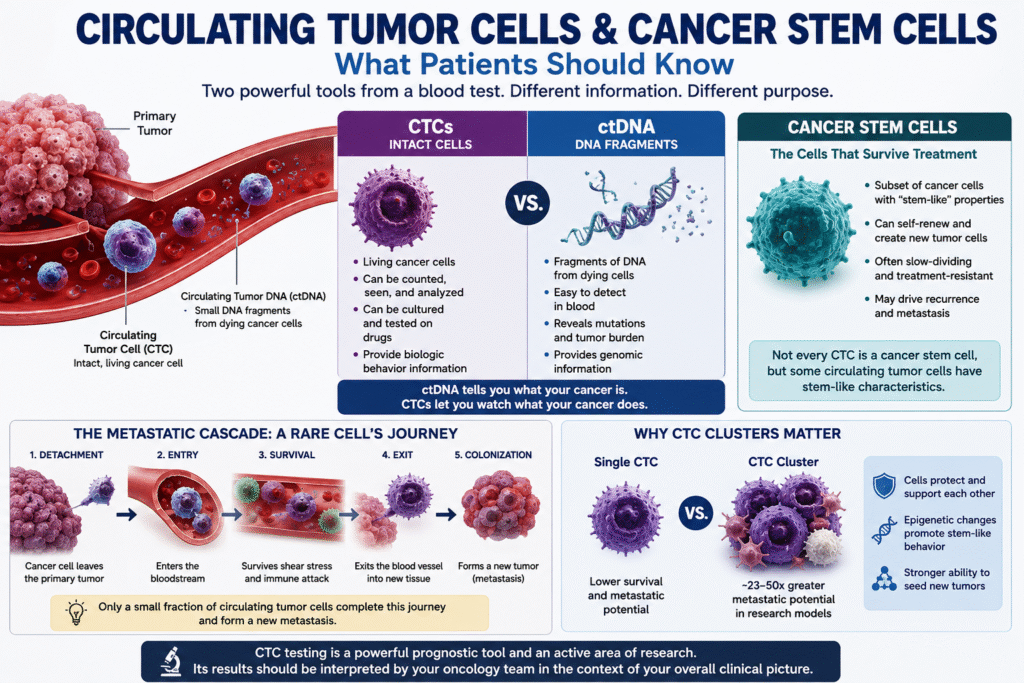
Circulating tumor cells are intact cancer cells that have detached from a tumor and entered the bloodstream. Unlike circulating tumor DNA, which consists of DNA fragments released from cancer cells, circulating tumor cells are whole cells that can potentially be counted, examined, stained for proteins, genetically analyzed, and studied for their biological behavior.
That distinction matters because an intact cell can potentially be counted, examined, stained for proteins, genetically analyzed, and in research settings even cultured. A DNA fragment cannot provide all of those forms of information.
What Are Circulating Tumor Cells?
The National Cancer Institute defines circulating tumor cells as cancer cells that have broken away from the original tumor and entered the bloodstream.
They are usually extremely rare compared with normal blood cells, which makes their detection technically challenging.
Most tumor cells entering the circulation probably do not successfully form metastases. To establish a distant tumor, a cell must survive circulation, evade immune defenses, leave the bloodstream, enter another tissue, and establish a viable colony.
CTCs therefore provide researchers with a direct opportunity to study cells involved in the metastatic process.
The National Cancer Institute notes that CTCs are being used as biomarkers in some cancers to help estimate prognosis and assist treatment planning.
Patients can learn more about how blood-based tumor testing differs from tissue testing in our guide to tissue biopsy vs liquid biopsy.
Circulating Tumor Cells Versus ctDNA
Both can be obtained from blood, but they provide different information.
ctDNA consists of small fragments of tumor-derived DNA circulating in the bloodstream. It can reveal genomic alterations and can be measured repeatedly during treatment.
Circulating tumor cells are intact cancer cells.
Because the cell itself remains available, researchers may examine cellular morphology, proteins, DNA, RNA, and other biological characteristics.
This makes CTCs particularly interesting for studying how cancer cells behave rather than simply identifying which mutations are present.
A useful way to think about the difference is this:
ctDNA provides molecular information released from the cancer.
CTCs provide intact cancer cells that can potentially be studied directly.
Neither test completely replaces the other.
Why Circulating Tumor Cell Clusters Matter
Circulating tumor cells do not always travel individually.
Sometimes several cancer cells travel together as a cluster.
This became an important area of metastasis research after investigators demonstrated that CTC clusters could have substantially greater metastatic potential than individual circulating tumor cells.
In a landmark 2014 study led by Nicola Aceto and colleagues, CTC clusters were uncommon compared with individual tumor cells, but in experimental breast cancer models they showed approximately 23 to 50 times greater metastatic potential.
The significance of this finding is important.
A cluster may provide cancer cells with survival advantages that an isolated circulating cell does not possess.
Later research found that clustering is associated with epigenetic changes involving stemness-related pathways and increased metastatic capability.
This does not mean that every patient with a CTC cluster will develop a new metastasis. It means that clusters represent a biologically important population of tumor cells that researchers are actively studying.
What Are Cancer Stem Cells?
The term cancer stem cell describes a tumor cell population with properties associated with self-renewal and the ability to regenerate heterogeneous populations of cancer cells.
The concept does not mean that every cancer is organized in exactly the same way as normal stem-cell tissue.
Cancer biology is more complicated.
Different tumors may contain cells with varying degrees of stem-like behavior, plasticity, treatment resistance, and capacity to regenerate disease.
Markers that have been studied include CD44, CD133, ALDH activity, and other molecular signatures. No single marker universally identifies a cancer stem cell across all malignancies.
The cancer stem-cell model remains biologically important, but it should not be presented as a rigid hierarchy that applies identically to every cancer.
Why Stem-Like Cancer Cells Are Important
One major concern is treatment resistance.
Many conventional chemotherapy drugs are especially effective against rapidly dividing cells.
Some tumor-cell populations can enter slower-cycling or relatively quiescent states and may therefore be less susceptible to treatments that depend strongly upon active cell division.
Other stem-like populations may possess enhanced DNA repair mechanisms, altered drug transport, resistance to apoptosis, metabolic adaptations, or interactions with protective tumor microenvironments.
These characteristics may contribute to persistence and eventual recurrence.
The important point is not that one mysterious “cancer stem cell” causes every relapse.
Rather, tumors can contain resistant cellular populations capable of surviving treatment and regenerating disease.
Are Circulating Tumor Cells Cancer Stem Cells?
Not necessarily.
This distinction is important.
A circulating tumor cell is defined by where the cell is located, namely in the bloodstream.
A cancer stem cell is defined by biological behavior, particularly self-renewal and tumor-initiating capacity.
Some circulating tumor cells may display stem-like characteristics.
Others may not.
CTC clusters appear particularly interesting because experimental research has linked clustering with transcriptional and epigenetic programs associated with stemness and metastatic capacity.
But it would be incorrect to say that every circulating tumor cell is a cancer stem cell.
How Are Circulating Tumor Cells Detected?
Different technologies use different methods.
Some rely upon proteins expressed on the surface of epithelial tumor cells.
Others separate cells according to physical characteristics such as size or deformability.
Newer approaches use microfluidics, imaging, molecular analysis, and increasingly automated image analysis.
The rarity and heterogeneity of CTCs remain major technical challenges.
What Is CellSearch?
CellSearch is an FDA-cleared system for enumerating circulating tumor cells.
It uses immunomagnetic enrichment to help isolate cells expressing epithelial markers, followed by additional staining and identification.
FDA records classify the CellSearch system as an immunomagnetic circulating cancer cell enumeration system.
One important limitation is that epithelial-marker-based systems may not detect every tumor cell equally well.
Cancer cells can change phenotype during processes such as epithelial-to-mesenchymal transition. Cells with lower expression of epithelial markers may therefore be more difficult for certain capture systems to identify.
This is one reason multiple CTC technologies have been developed.
What Does the Number of CTCs Mean?
In several metastatic cancers, higher circulating tumor cell counts have been associated with poorer prognosis.
One of the classic examples is metastatic breast cancer.
The landmark Cristofanilli study showed that higher CTC counts were associated with shorter progression-free and overall survival.
CTC thresholds have subsequently been studied in metastatic breast, prostate, and colorectal cancers.
However, a CTC count is primarily a prognostic biomarker.
It should not automatically be interpreted as a treatment prescription.
Can CTC Counts Guide Treatment?
This question has been tested clinically.
The STIC CTC randomized trial evaluated patients with hormone receptor-positive, HER2-negative metastatic breast cancer. Treatment choice between endocrine therapy and chemotherapy was based either on conventional clinical assessment or on CTC count.
The CTC-guided strategy was noninferior to the clinician-guided strategy for progression-free survival.
This was an important finding because it demonstrated genuine clinical utility for CTC enumeration in a defined setting.
But it does not mean that circulating tumor cell testing can presently select every cancer therapy for every patient.
That would go far beyond the evidence.
Can Circulating Tumor Cells Be Tested Against Cancer Drugs?
This is one of the most interesting areas of research.
Because CTCs are intact cells, investigators have attempted to culture them outside the body and expose them to anticancer drugs.
A landmark study demonstrated that circulating breast cancer cells could be cultured ex vivo and tested for drug susceptibility.
This creates the possibility of functional testing, where researchers ask not simply whether a cancer carries a mutation but whether living tumor cells actually respond to a particular drug.
That concept is scientifically compelling.
However, clinical use requires caution.
CTC culture and drug sensitivity testing remain substantially less standardized than established genomic testing, pathology, and approved companion diagnostic assays. Patients considering commercial functional CTC testing should understand whether the assay has prospective clinical validation demonstrating that treatment decisions based upon the test improve patient outcomes.
Can CTC Testing Detect Metastasis?
Not by itself.
Finding circulating tumor cells does not prove that metastatic disease has established itself in another organ.
CTCs can enter the bloodstream without successfully forming a metastatic tumor.
Imaging and clinical evaluation remain necessary for determining whether metastatic disease is present.
CTCs provide biological and prognostic information. They are not a substitute for staging.
CTCs and Cancer Monitoring
Serial CTC measurements can sometimes provide information about treatment response.
If a patient begins with an elevated CTC count and the count falls during effective treatment, that may be an encouraging sign.
Persistent or increasing CTC counts can be associated with poorer outcomes in some settings.
However, modern cancer monitoring increasingly includes several complementary tools, including imaging, conventional tumor markers, ctDNA, pathology, and clinical assessment.
CTC testing should therefore be interpreted within the entire clinical picture.
Where the Evidence Is Strongest
The strongest evidence currently supports CTC enumeration as a prognostic biomarker in selected metastatic cancers.
Evidence also supports serial CTC measurement as a way of obtaining additional information about disease course in some settings.
Clinical evidence for using CTC counts to guide treatment exists in particular situations, such as the STIC CTC breast cancer trial.
More sophisticated uses remain investigational.
These include culturing circulating tumor cells, testing drug sensitivity, performing extensive single-cell sequencing, characterizing CTC clusters, and specifically targeting stem-like circulating tumor cells.
This distinction is important when evaluating commercial testing.
Should CTC Testing Be Done Along With ctDNA?
Sometimes the tests can provide complementary information.
ctDNA is currently much more established for identifying actionable genomic alterations and for molecular monitoring in several cancers.
CTCs offer different information because they preserve the intact tumor cell.
Whether both are useful depends upon the cancer, stage, purpose of testing, available therapies, and whether the result would actually alter management.
More testing is not automatically better testing.
The clinically important question is whether the information obtained can meaningfully improve the treatment decision.
The Most Important Point
Cancer does not spread simply because DNA fragments appear in the bloodstream.
Metastasis ultimately requires living cancer cells capable of surviving, traveling, entering new tissue, and establishing a new tumor.
Circulating tumor cells provide a rare opportunity to study those living cells directly.
CTC clusters and stem-like tumor-cell populations may help researchers understand why some cancer cells survive treatment and why some are capable of establishing metastases.
But the science must be separated from claims that run ahead of clinical evidence.
Today, circulating tumor cells are established prognostic biomarkers in several metastatic cancers and increasingly sophisticated research tools.
Their future may extend much further.
Educational Disclaimer
This article is provided for general cancer education only. It is not medical advice and does not establish a physician-patient relationship. Circulating tumor cell testing, ctDNA testing, genomic testing, and functional assays should be selected and interpreted by qualified medical professionals in the context of the patient’s cancer type, stage, pathology, treatment history, and available therapeutic options.
References
- National Cancer Institute. Circulating Tumor Cell. NCI Dictionary of Cancer Terms. The NCI defines a CTC as a cancer cell that leaves the primary tumor and enters the bloodstream.
- Cristofanilli M, Budd GT, Ellis MJ, et al. Circulating Tumor Cells, Disease Progression, and Survival in Metastatic Breast Cancer. New England Journal of Medicine. 2004;351:781-791.
- Aceto N, Bardia A, Miyamoto DT, et al. Circulating Tumor Cell Clusters Are Oligoclonal Precursors of Breast Cancer Metastasis. Cell. 2014;158:1110-1122. Experimental models demonstrated substantially greater metastatic potential of CTC clusters compared with single CTCs.
- Gkountela S, Castro-Giner F, Szczerba BM, et al. Circulating Tumor Cell Clustering Shapes DNA Methylation to Enable Metastasis Seeding. Cell. 2019;176:98-112. The study linked CTC clustering with epigenetic programs associated with stemness and metastatic capability.
- Bidard FC, Jacot W, Kiavue N, et al. Efficacy of Circulating Tumor Cell Count-Driven vs Clinician-Driven First-Line Therapy Choice in Hormone Receptor-Positive, HER2-Negative Metastatic Breast Cancer. JAMA Oncology. 2021;7:34-41.
- de Bono JS, Scher HI, Montgomery RB, et al. Circulating Tumor Cells Predict Survival Benefit From Treatment in Metastatic Castration-Resistant Prostate Cancer. Clinical Cancer Research. 2008;14:6302-6309.
- Yu M, Bardia A, Aceto N, et al. Ex Vivo Culture of Circulating Breast Tumor Cells for Individualized Testing of Drug Susceptibility. Science. 2014;345:216-220.
- Batlle E, Clevers H. Cancer Stem Cells Revisited. Nature Medicine. 2017;23:1124-1134.
- Alix-Panabières C, Pantel K. Liquid Biopsy: From Discovery to Clinical Application. Cancer Discovery. 2021;11:858-873.