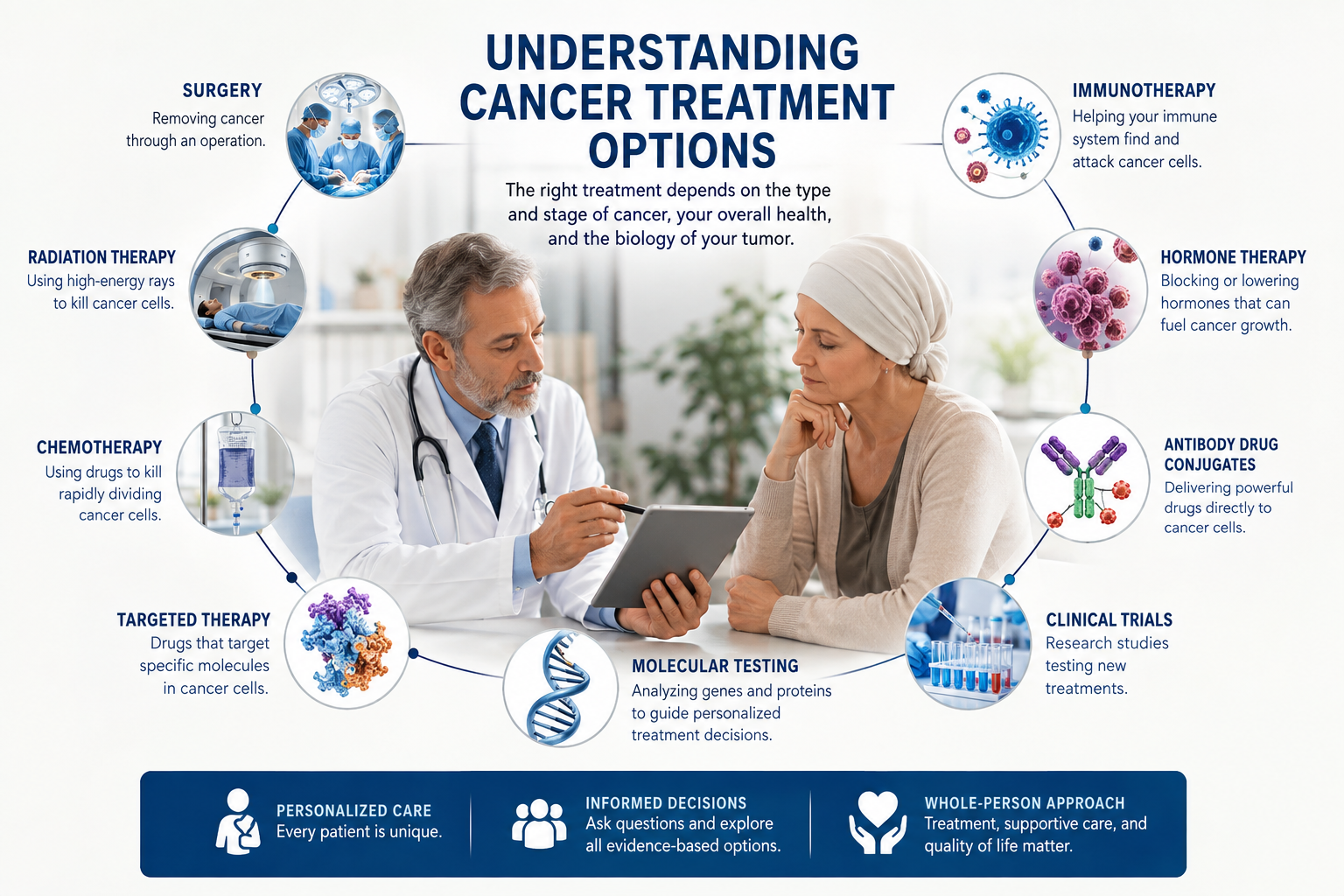
A diagnosis of cancer can make treatment seem confusing. You should know and understand your cancer treatment options. Patients may hear about surgery, chemotherapy, radiation, immunotherapy, targeted drugs, hormone therapy, antibody-drug conjugates, molecular testing, clinical trials, and other approaches almost immediately. Cancer treatment options now include both traditional therapies and treatments selected according to the molecular biology of the tumor.
The most important principle is that cancer treatment is not one size fits all.
Two patients can develop cancer in the same organ and still have biologically different diseases. The correct treatment depends on the cancer type, stage, pathology, molecular characteristics, previous treatments, overall health, and the goal of therapy.
Modern oncology increasingly combines traditional information such as tumor location and stage with information about the biology of the cancer itself. Biomarker testing can identify genes, proteins, and other characteristics that may help determine whether particular treatments are likely to work.
If you want to understand why cancers can behave so differently, read my article What Really Causes Cancer?
The First Question Is What Are We Treating?
Before choosing treatment, physicians need to establish exactly what type of cancer is present.
The pathology report remains fundamental. It identifies the type of malignant cell and often provides information about grade and other biological characteristics.
The next question is how far the cancer has spread. Imaging may include CT, MRI, PET imaging, bone scanning, ultrasound, or other studies depending upon the particular cancer.
The stage can substantially change the purpose of treatment. A small localized cancer may sometimes be treated with surgery or radiation with curative intent. Metastatic disease usually requires treatment capable of reaching cancer cells throughout the body.
Increasingly, physicians also examine the molecular characteristics of the tumor. Molecular testing can reveal genetic alterations, proteins, receptors, DNA repair abnormalities, or immune biomarkers that may create therapeutic opportunities.
This is one reason the name of the cancer alone is no longer enough to describe every treatment possibility. Choosing among cancer treatment options requires an understanding of the stage, pathology, and overall health of the patient.
Surgery
Surgery remains one of the most important treatments for solid tumors.
When cancer is localized and can be completely removed, surgery may sometimes be curative. Surgery can also provide tissue needed to determine the exact pathology, evaluate lymph nodes, establish stage, and perform additional molecular testing.
The extent of surgery depends upon the cancer.
Some operations remove only the tumor and a surrounding margin of normal tissue. Others require removal of part or all of an organ. Advances in minimally invasive, laparoscopic, robotic, image-guided, and organ-preserving techniques have changed surgery considerably.
Surgery is primarily a local treatment. It removes disease that the surgeon can identify and reach. It does not generally eliminate microscopic malignant cells that may already have traveled elsewhere.
That is why surgery is frequently combined with systemic treatment before or after an operation. The National Cancer Institute recognizes surgery as one of the major established modalities of cancer treatment.
Radiation Therapy
Radiation therapy uses high-energy radiation to damage the DNA of cancer cells and prevent them from continuing to divide.
Radiation can be given externally or, in selected circumstances, delivered internally or through radiopharmaceutical approaches.
Modern radiation oncology has become increasingly precise. Technologies such as intensity-modulated radiation therapy, stereotactic body radiation therapy, stereotactic radiosurgery, and proton therapy can concentrate radiation within defined areas while attempting to reduce exposure of surrounding normal tissues.
Radiation can have several different purposes.
It may be used to eradicate a localized tumor, reduce the risk of recurrence after surgery, shrink a tumor before surgery, control a limited metastatic site, or relieve symptoms such as pain, bleeding, obstruction, or neurologic compression.
Radiation remains fundamentally a local or regional treatment, although newer radiopharmaceutical approaches can deliver radiation to cancer cells at multiple locations in the body.
Chemotherapy Still Has an Important Role
Chemotherapy uses medications that interfere with the ability of cancer cells to grow and divide.
Because many chemotherapy drugs affect rapidly dividing cells, they may also affect normal tissues including bone marrow, gastrointestinal cells, hair follicles, and other rapidly renewing tissues. This accounts for many of the familiar side effects associated with chemotherapy.
However, it would be incorrect to think that chemotherapy has become obsolete.
Chemotherapy remains essential in the treatment of many leukemias, lymphomas, breast cancers, colorectal cancers, lung cancers, ovarian cancers, testicular cancers and numerous other malignancies.
Its role varies greatly according to the disease.
Chemotherapy may be given before surgery to reduce the size of a tumor. This is called neoadjuvant treatment.
It may be given after surgery to destroy microscopic residual disease and reduce recurrence risk. This is called adjuvant treatment.
In metastatic disease, chemotherapy may be used to control cancer, relieve symptoms and extend survival.
Some cancer treatment options are designed to cure localized disease, while others are intended to control advanced cancer.
Modern oncology increasingly selects chemotherapy according to tumor type and biological characteristics rather than simply giving the same treatment to everyone with cancer.
Targeting the Machinery Inside Cancer Cells
One of the major developments in oncology has been targeted therapy.
Cancer cells frequently acquire molecular abnormalities that allow them to grow, divide, resist cell death, create blood vessels, invade surrounding tissue, and spread.
Some of those abnormalities can be targeted with drugs.
Examples include alterations involving HER2, EGFR, BRAF, ALK, ROS1, RET, NTRK, KRAS, BRCA related DNA repair pathways and many others.
Targeted treatments may include monoclonal antibodies or small molecule drugs.
Unlike traditional chemotherapy, targeted therapies are designed around particular molecular characteristics of the malignant cell. That does not mean they have no side effects. It means that the treatment is directed toward a defined biological vulnerability.
The National Cancer Institute describes targeted therapy as treatment directed against proteins controlling cancer growth, division and spread and considers it a foundation of precision medicine.
This is why comprehensive molecular profiling can be important in selected cancers, particularly advanced cancers where several treatment possibilities may exist.
Using the Immune System Against Cancer
The immune system constantly distinguishes normal cells from potentially dangerous cells.
Cancer creates a special problem because cancer cells originate from our own tissues. Malignant cells can develop mechanisms that allow them to evade or suppress immune attack.
Immunotherapy attempts to overcome some of these mechanisms.
One major class is immune checkpoint inhibitors.
Drugs targeting PD 1, PD L1 and CTLA 4 can remove inhibitory signals that prevent immune cells from attacking certain cancers.
Pembrolizumab, commercially known as Keytruda, and nivolumab, commercially known as Opdivo, are examples of PD 1 inhibitors. Other checkpoint inhibitors target related immune pathways.
But immunotherapy does not work equally well for every patient.
Depending upon the cancer, physicians may examine biomarkers such as PD L1 expression, microsatellite instability, mismatch repair deficiency and tumor mutational burden. These biomarkers can provide information about whether a tumor may be susceptible to immune treatment.
Other immunotherapy approaches include cellular therapies. CAR T cell therapy and tumor infiltrating lymphocyte therapy involve collecting or modifying immune cells and using them therapeutically against cancer.
Hormones Can Become Cancer Growth Signals
Some cancers depend heavily upon hormones.
This is particularly important in breast and prostate cancer.
Many breast cancers contain estrogen receptors. Estrogen signaling can stimulate those cancers to grow.
Treatment can therefore reduce estrogen production, block the estrogen receptor, or degrade the receptor.
Prostate cancer is commonly driven by androgen signaling. Treatments can substantially reduce testosterone production or interfere with the androgen receptor.
This is known as endocrine or hormone therapy.
Hormonal treatment may control susceptible cancers for years in some patients, but cancer cells can eventually develop resistance mechanisms. When that happens, additional molecular testing or another treatment strategy may become appropriate.
The National Cancer Institute defines hormone therapy as treatment that slows or stops cancers that depend upon hormones for growth.
Antibody Drug Conjugates
Another important development has been the antibody drug conjugate.
These therapies combine the targeting ability of an antibody with a cancer-killing drug.
The antibody recognizes a protein found on the cancer cell. The drug-antibody complex attaches to the target and delivers its therapeutic payload to or near the malignant cell.
Examples now used in oncology include trastuzumab deruxtecan, commercially known as Enhertu, and sacituzumab govitecan, commercially known as Trodelvy.
This strategy demonstrates an important direction in modern cancer treatment. Rather than exposing every cell to the same concentration of a cytotoxic drug, scientists are attempting to deliver treatment more selectively according to features expressed by cancer cells.
Why Molecular Testing Matters
Molecular testing is one of the most important concepts for patients to understand.
A traditional pathology report tells us what the cancer looks like.
Molecular testing can sometimes tell us more about what is driving it.
Testing may evaluate DNA mutations, gene amplifications, deletions, rearrangements, fusion genes, RNA expression, proteins, hormone receptors, immune markers, and abnormalities involving DNA repair.
Not every alteration has a treatment.
Not every cancer requires extensive genomic testing.
And finding a mutation does not automatically mean that a targeted drug will work.
The purpose is to identify information that may actually change a treatment decision.
The National Cancer Institute describes biomarker testing as analysis of genes, proteins and other substances that can provide information about a cancer and may help physicians choose therapy.
Cancer Changes Over Time and Your Cancer Treatments Should Too
Cancer is not biologically static.
Tumors contain populations of malignant cells with different characteristics. Treatment creates selective pressure. Sensitive cells may die while resistant populations survive.
Those resistant cells can eventually become dominant.
As a result, a metastatic tumor several years after diagnosis may not be biologically identical to the original cancer.
This is one reason repeat biopsy or repeat molecular testing may sometimes become appropriate when cancer progresses.
Liquid biopsy can also sometimes detect tumor-derived DNA circulating in the bloodstream and identify molecular alterations without another tissue biopsy. However, tissue and blood testing have different strengths and limitations and are not interchangeable in every circumstance.
The best cancer treatment options may change if the cancer develops resistance or new molecular abnormalities.
Combination Cancer Treatment Is Often Necessary
Cancer frequently involves multiple biological processes simultaneously.
For that reason, effective cancer treatment options often combine modalities.
A patient might receive chemotherapy and immunotherapy before surgery, followed by surgery and radiation.
Another patient may receive hormone therapy together with a targeted drug.
Someone with metastatic cancer might receive systemic therapy while radiation is used to control a painful bone metastasis.
There is no contradiction in combining treatments.
Each component may be addressing a different part of the cancer problem.
Supportive and Integrative Care
Cancer treatment involves more than attacking the tumor.
Nutrition, physical activity when medically appropriate, sleep, psychological health, management of treatment related symptoms and appropriate rehabilitation can all be important components of care.
Integrative oncology can include supportive approaches used alongside conventional cancer treatment.
The critical word is alongside.
Complementary strategies should not replace a potentially curative cancer treatment simply because they are described as natural.
Supplements and repurposed medications also require careful evaluation because they can interact with chemotherapy, targeted drugs, anticoagulants, hormonal treatments and other medications.
The goal should be to build a treatment program in which the different components make biological and medical sense together.
Clinical Trials Should Not Be Viewed Only as a Last Resort
Clinical trials are how new cancer treatments become established treatments.
A trial may evaluate a new drug, a new combination, a new sequence of established treatments, a biomarker-selected therapy, cellular therapy, or another treatment strategy.
Clinical trials are sometimes appropriate early in treatment, not merely after every conventional therapy has failed.
The National Cancer Institute conducts and supports biomarker-driven trials designed to match molecular characteristics of cancers with therapies that may exploit those vulnerabilities.
Patients with uncommon cancers, resistant disease, or potentially actionable molecular abnormalities should ask whether an appropriate clinical trial exists.
The Treatment Plan Must Fit the Patient
The most sophisticated cancer treatment is not necessarily the treatment containing the greatest number of drugs.
It is the treatment that fits the individual cancer and the individual patient.
Physicians must consider the pathology, stage, molecular characteristics, treatment history, organ function, other medical conditions, expected benefits, potential toxicity, and the patient’s own priorities.
This is precision oncology.
The central question is increasingly not simply:
“What treatment is used for this type of cancer?”
A better question is:
“What is driving this particular cancer, what treatments have evidence of benefit, and which strategy offers this particular patient the best balance between potential benefit and risk?”
Cancer treatment has become increasingly complex because our understanding of cancer has become increasingly sophisticated.
That complexity can be intimidating.
But it also creates opportunities that did not exist even a decade ago.
For a comprehensive overview of established cancer treatments, patients can also review the National Cancer Institute: Types of Cancer Treatment.
Conclusion
Cancer treatment may involve surgery, radiation, chemotherapy, hormone therapy, targeted treatment, immunotherapy, antibody drug conjugates, cellular therapy, radiopharmaceutical therapy, clinical trials, or combinations of these approaches.
The correct treatment cannot be determined from the name of the cancer alone.
Understanding the biology of the tumor can be as important as understanding where it started.
Modern cancer care therefore brings together pathology, imaging, staging, molecular testing, clinical evidence and the individual patient’s medical condition.
The objective is not simply to treat cancer.
The objective is to understand the cancer well enough to choose the treatment most likely to benefit the person who has it.
Educational Disclaimer
This information is provided for educational purposes only. It does not constitute medical advice, diagnosis, treatment, or prescribing.
Cancer treatment must be individualized. Patients should discuss treatment decisions with their treating oncologist after review of their complete pathology, imaging, laboratory studies, molecular and genetic testing, previous treatments, and overall medical condition.
This educational material does not establish a physician-patient relationship.
Dr. Dean Silver
References
- National Cancer Institute. Types of Cancer Treatment. National Cancer Institute. Current online cancer treatment resource.
- National Cancer Institute. Biomarker Testing for Cancer Treatment. National Cancer Institute.
- National Cancer Institute. Targeted Therapy to Treat Cancer. National Cancer Institute.
- National Cancer Institute. Immunotherapy to Treat Cancer. National Cancer Institute.
- National Cancer Institute. Radiation Therapy to Treat Cancer. National Cancer Institute.
- National Cancer Institute. Hormone Therapy to Treat Cancer. National Cancer Institute. Updated May 15, 2025.
- National Cancer Institute. T Cell Transfer Therapy. National Cancer Institute.
- National Cancer Institute. Precision Medicine. NCI Dictionary of Cancer Terms.
- National Cancer Institute. Radiopharmaceuticals Emerging as New Cancer Therapy. NCI Cancer Currents.
- Hanahan D. Hallmarks of Cancer: New Dimensions. Cancer Discovery. 2022; 12:31 to 46.
- Malone ER, Oliva M, Sabatini PJB, Stockley TL, Siu LL. Molecular profiling for precision cancer therapies. Genome Medicine. 2020; 12:8.
- Tsimberidou AM, Fountzilas E, Nikanjam M, Kurzrock R. Review of precision cancer medicine: evolution of the treatment paradigm. Cancer Treatment Reviews. 2020; 86:102019.