Comprehensive tumor profiling can reveal information about a cancer that may not be visible under a microscope or detected by a small molecular panel. But not every test described as “comprehensive” examines the same amount of information.
Some cancer tests analyze a few dozen genes. Others examine several hundred cancer related genes. Certain platforms now combine whole exome sequencing of DNA with whole transcriptome sequencing of RNA, examining more than 20,000 genes and adding selected protein biomarkers.
The distinction matters. If an alteration is not included in the assay being performed, that test cannot report it.
Understanding what was actually tested can therefore be just as important as reading the final report.
What Is Comprehensive Tumor Profiling?
The term refers broadly to molecular testing designed to characterize abnormalities that may be driving a patient’s cancer.
Depending upon the laboratory and test selected, profiling may include DNA mutations, gene amplifications, deletions, rearrangements, gene fusions, RNA expression, tumor mutational burden, microsatellite instability, and selected protein biomarkers.
Some platforms examine hundreds of predefined cancer related genes. Others go substantially further.
For example, Caris currently describes its MI Profile as analyzing more than 23,000 genes through simultaneous whole exome sequencing and whole transcriptome sequencing, together with analysis of selected tumor related proteins.
These approaches provide three potentially complementary layers of information.
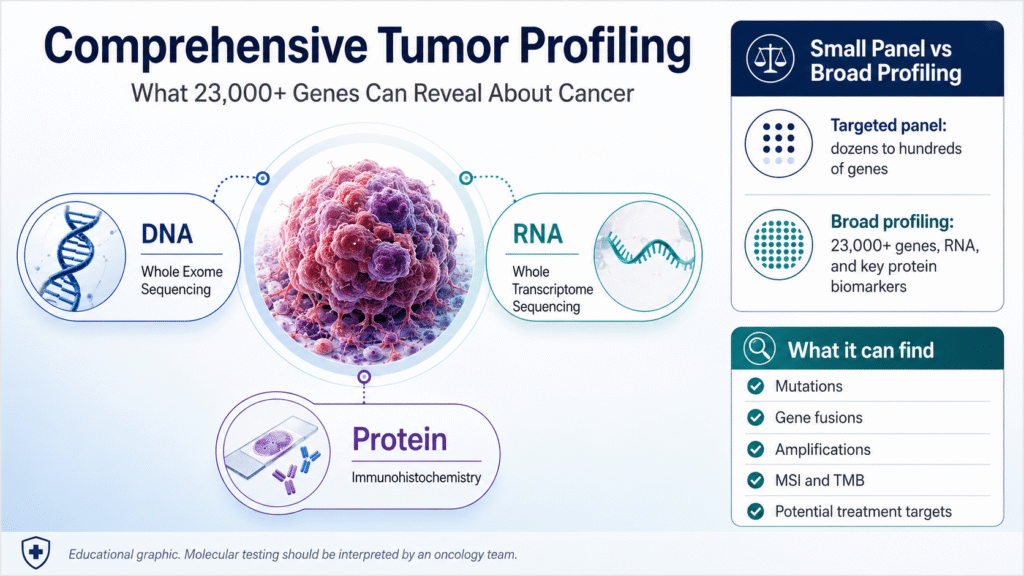
DNA: Whole Exome Sequencing
The exome represents the protein coding portion of the genome.
Whole exome sequencing can examine coding regions broadly rather than restricting the analysis to a predetermined list of common cancer genes. It may identify mutations, insertions, deletions, copy number abnormalities and other genomic alterations.
Caris, for example, currently describes its whole exome assay as analyzing approximately 23,000+ DNA genes.
This does not mean every abnormality discovered will be clinically meaningful or treatable. It means that the search is substantially broader.
RNA: Whole Transcriptome Sequencing
DNA tells us what genetic information is present. RNA gives us another view of which genes are being transcribed and can be especially valuable for detecting certain gene rearrangements and fusions.
RNA sequencing can identify clinically important fusion events that may be difficult to detect using some DNA based approaches alone.
This is particularly important for alterations involving genes such as ALK, ROS1, RET, and NTRK. Research in lung adenocarcinoma has demonstrated that RNA sequencing can identify actionable kinase fusions in tumors where DNA sequencing did not identify a driver alteration.
RNA therefore does not replace DNA sequencing. It provides complementary information.
Protein: Immunohistochemistry
Genomic testing also does not replace direct examination of proteins within tumor tissue.
Immunohistochemistry, commonly called IHC, remains important for biomarkers such as PD-L1 and HER2 in appropriate cancers.
The most informative profiling strategy may therefore combine DNA, RNA and selected protein measurements rather than relying upon any one layer alone.
Panel Testing Versus Broader Tumor Profiling
One of the most important points for patients is that the word “comprehensive” does not have one universal meaning.
FoundationOne CDx, for example, is an FDA approved tissue based comprehensive genomic profiling assay that currently analyzes 324 genes.
Tempus xT CDx is currently described as a 648 gene tissue based assay, with RNA sequencing capabilities available within the Tempus testing platform.
Caris MI Profile takes a different approach, combining whole exome and whole transcriptome sequencing involving more than 23,000 genes with protein biomarker analysis.
These are therefore not interchangeable tests.
A several hundred gene panel may be entirely appropriate when the important treatment associated biomarkers for a particular cancer are well established.
Broader testing may become particularly interesting in advanced cancer, unusual tumors, cancers without an obvious molecular driver, or disease that has progressed through multiple lines of therapy.
The question should not simply be, “Did I have genomic testing?”
A better question is:
Exactly what did my test examine?
Why RNA Can Add Important Information
RNA deserves special attention because certain clinically important abnormalities involve gene rearrangements and fusion transcripts.
A gene fusion occurs when portions of two genes become joined. The resulting fusion may create an abnormal signaling protein that drives cancer growth.
Some of these abnormalities are highly actionable.
For example, NTRK gene fusions can predict sensitivity to TRK inhibitors in appropriate patients. Other actionable fusion driven cancers may involve ALK, ROS1, RET, or FGFR alterations.
RNA based testing can improve fusion detection in selected circumstances. In a study of lung adenocarcinomas that appeared negative for driver alterations on DNA testing, RNA sequencing identified additional targetable kinase fusions.
This is why I believe patients should ask whether their molecular testing included RNA as well as DNA.
What Can Comprehensive Tumor Profiling Find?
Targetable Genomic Alterations
Testing may identify mutations or other abnormalities associated with FDA approved targeted treatments.
Examples can include alterations involving EGFR, BRAF, BRCA1, BRCA2, KRAS, ERBB2/HER2, PIK3CA, and ESR1, depending upon the cancer type and clinical setting.
However, finding a mutation does not automatically mean that a drug should be used.
The meaning of an alteration depends upon the patient’s cancer type, stage, previous treatment, level of evidence, FDA indication and available clinical trials.
The FDA maintains an updated list of approved companion diagnostic tests linking particular biomarkers with particular therapies.
External link: Highlight the words FDA approved companion diagnostics and link them to the FDA Companion Diagnostic Devices page.
Gene Fusions
Fusion detection may uncover treatment options that would otherwise be missed.
This is one of the strongest reasons for asking whether RNA sequencing was included, particularly when conventional testing has failed to identify a clear oncogenic driver.
Amplifications and Copy Number Changes
Cancer cells may acquire additional copies of particular genes or lose important tumor suppressor genes.
HER2 amplification is a classic example of increased gene copy number.
Losses involving genes such as PTEN or CDKN2A can also provide important biological or prognostic information and may affect clinical trial eligibility.
These findings do not necessarily have an approved treatment attached to them, but they can help describe the molecular architecture of the cancer.
Immunotherapy Biomarkers: MSI, TMB and PD-L1
Several different biomarkers may help determine whether immunotherapy deserves consideration, but they should not be treated as interchangeable.
Microsatellite instability, or MSI, and mismatch repair deficiency, or dMMR, can predict benefit from immune checkpoint inhibitors in several clinical settings. Pembrolizumab became the first FDA approved tissue agnostic cancer treatment based upon MSI-H or dMMR rather than the organ in which the tumor originated.
Tumor mutational burden, or TMB, measures the number of mutations within a defined amount of tumor DNA. An FDA approved indication exists for pembrolizumab in selected patients with unresectable or metastatic TMB-high solid tumors, defined for this indication as at least 10 mutations per megabase, after prior treatment when satisfactory alternative treatment options are unavailable.
That qualification is important. A TMB of 10 does not mean every patient automatically needs immunotherapy.
PD-L1 is generally measured at the protein level by immunohistochemistry. Its interpretation varies according to tumor type, assay, scoring system and treatment being considered.
A good molecular report should therefore be interpreted in the context of the specific cancer rather than treating MSI, TMB and PD-L1 as three versions of the same test.
The Limits of Comprehensive Tumor Profiling
Molecular profiling can be extraordinarily useful, but patients should understand its limitations.
Not Every Finding Is Treatable
A report may contain many genomic alterations while identifying only a few with established therapeutic significance.
Real world data illustrate the difference between finding an alteration and actually receiving a matched treatment. A 2025 meta-analysis reported actionable genomic alterations in approximately 60 percent of comprehensively profiled patients, while substantially fewer ultimately received targeted therapy.
The percentage varies widely according to cancer type, disease stage, test used and how “actionable” is defined.
Tissue Can Be Inadequate
Small biopsies may contain insufficient tumor.
Necrosis, low tumor content and specimen processing can also interfere with molecular analysis. Decalcified bone specimens can present particular difficulties for some molecular assays.
For this reason, the pathology specimen itself matters.
One Biopsy Cannot Represent Every Cancer Cell
Cancer is heterogeneous.
Different metastatic sites may contain different populations of cancer cells. Treatment can also select resistant clones over time.
A molecular profile therefore represents the tumor material that was sampled at a particular point in the disease.
This is one reason tissue testing and circulating tumor DNA testing can sometimes provide complementary information.
Internal link: Highlight circulating tumor DNA testing and link it to your blood test or liquid biopsy article.
Broader Data Does Not Automatically Mean Better Treatment
The largest molecular test is not automatically the best test for every patient.
In some cancers, a focused panel already includes the biomarkers needed to make the immediate treatment decision.
Broader sequencing becomes most useful when the additional information can affect treatment selection, clinical trial identification, resistance analysis or future interpretation.
Can the Data Be Reanalyzed Later?
Potentially, but this needs to be stated carefully.
One theoretical advantage of broad DNA and RNA sequencing is that a large amount of molecular information is generated at one time.
As cancer knowledge changes, previously uncertain findings may become clinically meaningful.
Whether an old specimen or sequencing dataset can actually be reanalyzed without another biopsy depends upon the laboratory, the data retained, specimen availability, assay policies and the clinical situation.
Patients should therefore ask:
Will my sequencing data be retained, and can it be reinterpreted later if new cancer treatments become available?
That is a much better question than assuming reanalysis occurs automatically.
How to Talk to Your Oncologist About Tumor Profiling
You do not need to understand thousands of genes to ask the right questions.
I would ask these five:
Was my tumor tested with DNA sequencing only, or were both DNA and RNA analyzed?
How many genes were actually examined?
Were important immunotherapy biomarkers such as MSI, TMB and PD-L1 evaluated when appropriate for my cancer?
Was there enough viable tumor tissue for reliable testing?
Would review by a molecular tumor board help interpret unusual or potentially actionable findings?
I would also ask for a copy of the complete molecular pathology report.
A molecular report should be considered part of your permanent cancer record.
Does Insurance Cover Comprehensive Tumor Profiling?
Coverage depends upon the patient’s cancer, test, insurer and clinical circumstances.
Medicare has a National Coverage Determination governing certain next generation sequencing tests in cancer. Coverage criteria include specific requirements concerning the patient’s cancer and the test being used. It should therefore not be assumed that every broad sequencing test is automatically covered.
Commercial insurance coverage varies.
When broad molecular testing is being considered, patients should ask the laboratory and insurer about coverage and potential financial responsibility before testing.
Should Tumor Profiling Be Repeated When Cancer Progresses?
Sometimes.
Cancer evolves.
A tumor that progresses after targeted therapy, endocrine therapy, chemotherapy or other treatment may acquire new resistance mechanisms that were not detectable earlier.
In selected cancers, repeat tissue biopsy or blood based molecular testing can therefore provide clinically useful information.
Whether retesting is appropriate depends upon the cancer, prior molecular findings, treatment received, available therapies and whether the result is likely to change management.
The Most Important Question
Cancer treatment increasingly depends upon understanding not only where a cancer began, but also what molecular mechanisms are driving it.
Comprehensive tumor profiling can help provide that information.
But patients should not be impressed simply because a report contains dozens of pages.
The important questions are what was measured, what was found, how strong the evidence is, and whether the information can actually change treatment.
The goal is not to collect the largest possible amount of molecular data.
The goal is to find information that helps make a better treatment decision.
Educational Disclaimer
This article is provided for general cancer education only. It is not medical advice and does not establish a physician patient relationship. Molecular testing should be selected and interpreted by qualified medical professionals in the context of the patient’s diagnosis, pathology, stage, previous treatment, overall health and available treatment options.
Dr. Silver
References
- Caris Life Sciences. MI Profile: Whole Exome and Whole Transcriptome Sequencing. Current product information describing simultaneous WES and WTS analysis of more than 23,000 genes with selected protein biomarkers.
- U.S. Food and Drug Administration. FoundationOne CDx. FDA information describing the tissue based assay and its analysis of 324 genes.
- Tempus AI. Tempus xT CDx. Current technical information describing the 648 gene tissue based molecular profiling assay.
- Benayed R, Offin M, Mullaney K, et al. High Yield of RNA Sequencing for Targetable Kinase Fusions in Lung Adenocarcinomas with No Mitogenic Driver Alteration Detected by DNA Sequencing. Clinical Cancer Research. 2019;25:4712-4722.
- U.S. Food and Drug Administration. FDA Approval of Pembrolizumab for Tumor Mutational Burden High Solid Tumors. FDA. 2020.
- Marcus L, Fashoyin-Aje LA, Donoghue M, et al. FDA Approval Summary: Pembrolizumab for the Treatment of Tumor Mutational Burden High Solid Tumors. Clinical Cancer Research. 2021;27:4685-4689.
- Zerdes I, et al. Comprehensive Genomic Profiling and Molecularly Matched Therapy: Real World Evidence and Meta Analysis. 2025. The analysis reported actionable alterations in 59.8 percent of profiled patients and matched therapy use in a substantially smaller proportion.
- Centers for Medicare & Medicaid Services. National Coverage Determination 90.2: Next Generation Sequencing.
- Chakravarty D, Solit DB. Clinical cancer genomic profiling. Nature Reviews Genetics. 2021;22:483-501.