Can old drugs fight cancer? Yes. Repurposed cancer drugs are attracting increasing interest because some familiar medications may influence biological pathways involved in cancer. Drugs originally developed for diabetes, infections, inflammation, cholesterol disorders, and other conditions are now being investigated for possible anticancer effects.
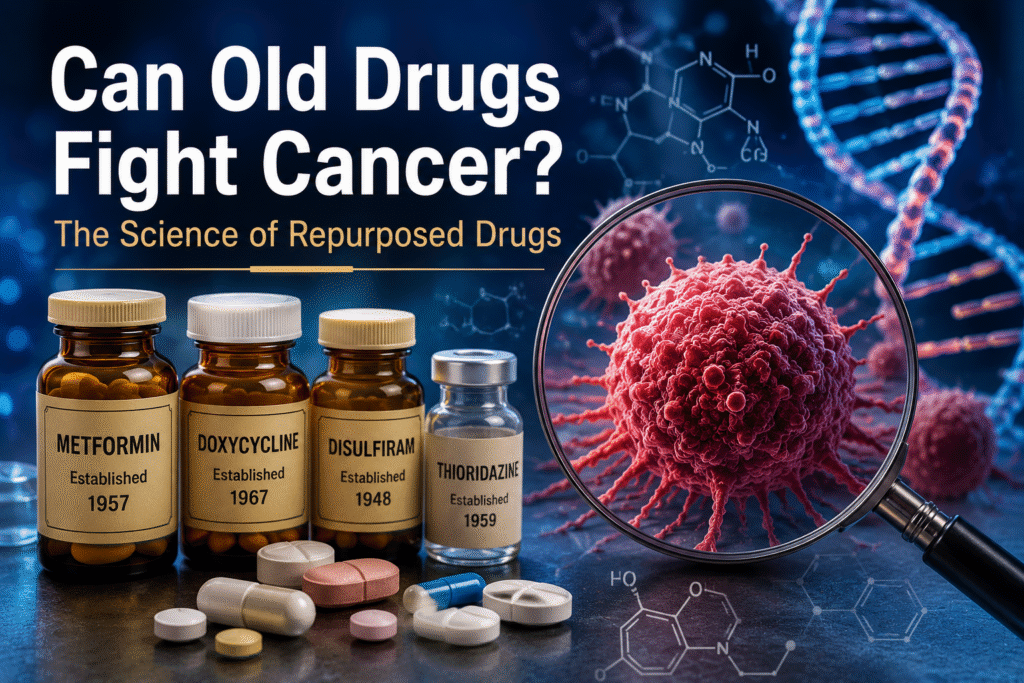
Repurposed drugs for cancer are existing medications investigated for a disease different from the condition for which they were originally developed.
Because these medications have already been used in humans, researchers often know considerable information about their pharmacology, dosing, adverse effects, and drug interactions. This can potentially shorten parts of the drug development process.
In cancer research, investigators are studying whether certain existing medications can interfere with cancer metabolism, cell signaling, inflammation, angiogenesis, autophagy, tumor growth, and the tumor microenvironment.
Why Could an Old Drug Affect Cancer?
Cancer is not controlled by one pathway.
A malignant cell may depend upon multiple interconnected biological systems that regulate metabolism, proliferation, blood vessel formation, inflammation, DNA repair, immune escape, and resistance to cell death.
A medication developed for another disease may unexpectedly interfere with one of these systems.
This does not automatically make it a cancer treatment. It creates a scientific hypothesis that must be tested.
Metformin
Metformin has been used for decades to treat type 2 diabetes.
Researchers became interested in metformin because it affects glucose and insulin physiology as well as intracellular energy signaling. Laboratory and observational studies generated considerable interest in its possible anticancer effects.
However, results from human trials have varied substantially. Metformin should therefore not be described as a general cancer treatment. Its potential usefulness may depend upon cancer type, stage, metabolic characteristics, and treatment setting.
Statins
Statins are primarily used to lower cholesterol and reduce cardiovascular risk.
Cancer cells require cholesterol and other lipid products for cellular membranes and signaling. This has led researchers to investigate whether statins could influence cancer growth or treatment response.
The biological rationale is interesting, but clinical evidence differs among cancers. Statins should not be prescribed as cancer therapy solely because laboratory studies suggest anticancer activity.
Propranolol
Propranolol is a beta blocker traditionally used for cardiovascular conditions.
Researchers have investigated whether beta adrenergic signaling influences tumor biology, including angiogenesis, cellular migration, stress signaling, and metastasis.
This is another example of drug repurposing in which a familiar medication may interact with biological pathways that were not the reason the medication was originally developed. Clinical evidence is still evolving.
Mebendazole
Mebendazole is an antiparasitic medication.
Laboratory research has suggested several potential anticancer mechanisms, including effects involving microtubules and cellular proliferation.
This has led to clinical investigation, but evidence from laboratory experiments should not be confused with evidence that mebendazole improves cancer survival. Mebendazole remains investigational as an anticancer strategy. A systematic review of randomized repurposing trials specifically included mebendazole among drugs evaluated in oncology research.
Itraconazole
Itraconazole is an antifungal medication that has attracted attention in oncology research.
Researchers have investigated effects involving angiogenesis and signaling pathways that may contribute to tumor growth.
Itraconazole illustrates an important principle. A drug can have biological actions extending far beyond the purpose for which it was originally developed. Whether those actions produce a meaningful clinical benefit must still be demonstrated for each particular cancer.
Aspirin and Anti-Inflammatory Drugs
Chronic inflammation contributes to the development and progression of several cancers.
This has generated considerable interest in aspirin and other anti-inflammatory medications.
However, potential anticancer benefits must be weighed against adverse effects, particularly gastrointestinal bleeding and other complications. Randomized evidence involving cardiovascular and anti-inflammatory drugs has produced mixed results, reinforcing the importance of evaluating individual drugs and cancers rather than treating repurposed drugs as a single therapeutic category.
Repurposed Drugs Are Not All Equal
This may be the most important point.
The term repurposed drug does not tell us how strong the evidence is.
One drug may have compelling laboratory evidence but almost no human evidence. Another may have observational studies. Another may have early clinical trials. A few repurposed medications eventually become established components of medical treatment.
Therefore, the relevant question is not simply:
“Does this drug kill cancer cells?”
The better questions are:
Has it been studied in humans?
At what dose?
For which cancer?
Was it combined with standard treatment?
Did it shrink tumors?
Did it delay progression?
Most importantly, did it improve survival or quality of life?
Systematic reviews of randomized trials emphasize that promising preclinical and observational findings require confirmation in properly designed clinical trials.
Combining Repurposed Drugs with Cancer Treatment
Another major research area involves combinations.
Cancer cells frequently develop resistance because they can activate alternative survival pathways. Researchers are therefore investigating whether repurposed medications could complement chemotherapy, targeted therapy, radiation therapy, or immunotherapy.
The scientific objective is not to take as many medications as possible. It is to identify a biologically rational target and determine whether interfering with that target improves treatment.
Drug interactions are particularly important. A medication that appears relatively safe when taken alone may behave differently when combined with chemotherapy, immunotherapy, anticoagulants, or other medications.
Personalized Cancer Treatment Matters
Modern oncology increasingly recognizes that cancers arising in the same organ can behave very differently.
Genomic and molecular testing can identify mutations, signaling pathways, receptors, and biomarkers that help characterize an individual cancer.
That information may eventually help researchers determine which metabolic or signaling vulnerabilities could be appropriate targets for both conventional and repurposed medications.
This is why drug repurposing is particularly interesting when considered within precision oncology rather than as a universal treatment strategy.
The Bottom Line
Can old drugs fight cancer?
Some may have anticancer activity, and drug repurposing is a legitimate and increasingly sophisticated area of cancer research. Existing medications may affect cancer metabolism, signaling pathways, inflammation, angiogenesis, autophagy, and other processes involved in tumor survival.
But promising mechanisms are not enough.
The critical issue is whether a particular drug, at a tolerable dose, improves meaningful outcomes for patients with a particular type of cancer.
Repurposed medications should therefore be evaluated according to the same principles used for other cancer therapies: biological rationale, clinical evidence, potential benefits, toxicity, drug interactions, and the individual characteristics of the patient’s cancer.
References
- Al Khzem AH, et al. Drug Repurposing for Cancer Treatment: A Comprehensive Review. International Journal of Molecular Sciences. 2024; 25:12441.
- Pantziarka P, et al. Drug Repurposing in Oncology: A Systematic Review of Randomized Controlled Clinical Trials. Cancers. 2023.
- Xia Y, et al. Drug repurposing for cancer therapy. Signal Transduction and Targeted Therapy. 2024; 9:92.
- Benjamin DJ, Haslam A, Prasad V. Cardiovascular/anti-inflammatory drugs repurposed for treating or preventing cancer: a systematic review and meta-analysis of randomized trials. Cancer Medicine. 2024;13: e7049.
- National Cancer Institute. Off-Label Drug Use in Cancer Treatment.
Educational Disclaimer
This article is for educational purposes only. It is not medical advice and does not establish a physician patient relationship. Repurposed and off label medications can cause adverse effects and drug interactions and should not replace established cancer treatment. Treatment decisions should be discussed with the patient’s treating oncologist.
Dr. Dean Silver, MD, MD (H)