Root cause testing for cancer looks for measurable factors that may have contributed to cancer risk, immune dysfunction, chronic inflammation, or the way your body responds to treatment. These factors may include chronic infections, dental infection, immune function, microbiome changes, metabolic health, and selected environmental exposures. Almost every patient asks the same question after a diagnosis.
Why did I get cancer?
Sometimes there is a recognizable explanation, such as tobacco exposure, radiation, an inherited pathogenic variant, chronic infection, or another known carcinogenic exposure. Often there is no single explanation. Cancer usually develops through an accumulation of genetic changes, environmental exposures, age related biology, immune changes, and random errors that occur as cells divide.
Root cause testing for cancer asks a second question. What potentially measurable factors in your body could have contributed to cancer risk, immune dysfunction, chronic inflammation, or your ability to tolerate and respond to treatment?
These may include chronic infections, immune function, dental infection, microbiome abnormalities, metabolic dysfunction, and selected environmental exposures. For more information see our page What Really Causes Cancer?
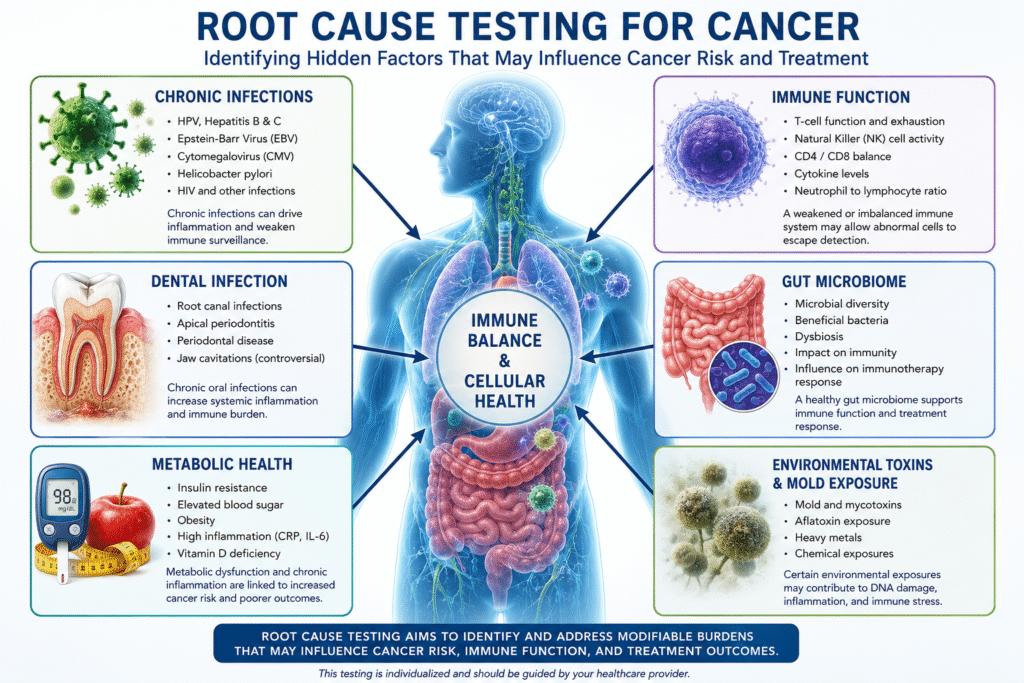
What Root Cause Testing for Cancer Can Reveal
Root cause testing for cancer does not mean that one laboratory test can tell you exactly why your cancer developed.
It means evaluating biological and environmental factors that may have contributed to cancer development or may still influence your health during treatment.
Two principles are essential.
The first is that association does not prove causation.
If a particular abnormality occurs more frequently in patients with cancer, that does not necessarily mean it caused the cancer. The cancer itself may have produced the abnormality, or both findings may share another cause.
The second is that not every abnormal test result changes cancer treatment.
Some findings may have direct clinical implications. Others identify potentially modifiable burdens such as infection, inflammation, or metabolic dysfunction that should be addressed because they affect general health and treatment tolerance.
Root Cause Testing for Cancer and Chronic Infections
Several infections are established causes of human cancer.
Human papillomavirus is responsible for cervical cancer and a substantial proportion of oropharyngeal cancers.
Hepatitis B and hepatitis C can cause hepatocellular carcinoma.
Helicobacter pylori increases the risk of gastric adenocarcinoma and gastric MALT lymphoma.
Epstein Barr virus is linked to several lymphomas, nasopharyngeal carcinoma, and some gastric cancers.
Human herpesvirus 8 causes Kaposi sarcoma.
HIV substantially increases cancer risk through immune suppression.
Globally, infections are estimated to account for approximately 13 percent of cancers.
This category matters because several of these conditions are treatable or preventable.
H. pylori can be eradicated.
Hepatitis C can often be cured.
Hepatitis B can be treated and monitored.
HPV associated disease can be reduced through vaccination and appropriate screening.
Root Cause Testing for Cancer and Immune Function
Persistent infection can alter immune function.
One mechanism is T cell exhaustion.
When T cells are repeatedly exposed to persistent antigen, they can progressively lose function. They may increase expression of inhibitory receptors such as PD 1, LAG 3, and TIM 3 and become less effective at producing cytokines and proliferating.
This biology is directly relevant to oncology because immune checkpoint inhibitors were developed in part to reverse inhibitory signaling within exhausted T cells.
Cytomegalovirus provides another example.
CMV remains in the body for life. In older adults, a substantial fraction of the memory T cell compartment may become devoted to controlling CMV. This phenomenon, sometimes called memory inflation, contributes to age related changes in immunity.
Chronic bacterial infection can also maintain inflammatory signaling through mediators including IL 6 and TNF alpha.
Chronic inflammation can promote oxidative DNA damage, angiogenesis, and an immune microenvironment that may favor tumor growth.
Mold, Mycotoxins, and Cancer
This area requires careful distinction.
Aflatoxin B1 is a well established human carcinogen. It is produced by certain Aspergillus species that may contaminate improperly stored grains, corn, and nuts.
Aflatoxin exposure can produce DNA damage and is strongly associated with hepatocellular carcinoma.
Risk is particularly significant when aflatoxin exposure occurs together with chronic hepatitis B infection.
That evidence should not be confused with claims regarding ordinary indoor mold exposure.
Damp building exposure is clearly associated with respiratory disease, asthma exacerbation, hypersensitivity reactions, and other pulmonary effects.
Claims that typical indoor mold exposure causes systemic immune suppression or common solid tumors are considerably less established.
Commercial urine mycotoxin testing exists, but interpretation remains debated. A positive test should therefore be considered a finding that may warrant further investigation rather than proof that mold caused a patient’s cancer.
Dental Infection and Cancer Care
Chronic oral infection deserves attention because it can be clinically silent.
Apical periodontitis is infection and inflammation around the root tip of a tooth. It can occur even after root canal treatment if infection persists or the treatment fails.
These lesions may remain present for years without significant pain.
Studies have associated chronic apical periodontitis with increased systemic inflammatory markers including C reactive protein and IL 6.
Another concept discussed in integrative and biological dentistry is jaw cavitation, sometimes referred to as neuralgia inducing cavitational osteonecrosis.
This remains controversial.
Apical periodontitis is a well recognized clinical entity. Cavitations as a separate pathological diagnosis remain disputed and are not universally accepted within mainstream dentistry.
What is much less controversial is the relationship between periodontal disease, systemic inflammation, and cancer epidemiology.
Research has reported associations between periodontal disease and several malignancies. Certain oral bacteria, including Fusobacterium nucleatum and Porphyromonas gingivalis, have also attracted considerable research interest.
Fusobacterium nucleatum is particularly interesting because it can be enriched within colorectal tumor tissue.
Active dental infection should therefore be treated for its own medical and dental reasons.
Timing is important in patients receiving chemotherapy, head and neck radiation, bisphosphonates, denosumab, or other treatments that may affect healing or the risk of osteonecrosis of the jaw.
Measuring Immune Function
Immune testing can provide useful information in selected patients.
Root Cause Testing for Cancer and Immune Cell Measurements
Flow cytometry can measure different lymphocyte populations, including CD4 T cells, CD8 T cells, B cells, and natural killer cells.
Natural killer cells are particularly interesting because they can recognize abnormal cells that have reduced expression of normal surface markers.
Functional NK assays attempt to measure what those cells can actually do rather than simply counting them.
Low natural killer cell activity has been associated with higher subsequent cancer incidence in population studies.
However, an important limitation remains.
Evidence that deliberately increasing an NK activity laboratory value improves cancer outcomes has not been established.
The Neutrophil to Lymphocyte Ratio
One of the simplest immune related measurements is already contained in an ordinary complete blood count.
The neutrophil to lymphocyte ratio, or NLR, compares circulating neutrophils with lymphocytes.
A higher NLR has been associated with worse prognosis across numerous solid tumors and has also been investigated as a marker associated with response to immunotherapy.
Thresholds vary considerably by cancer type and clinical setting, so NLR should not be interpreted as a universal cutoff.
Its value is that it provides a simple measure of the relationship between systemic inflammation and adaptive immune capacity.
Root Cause Testing for Cancer and the Microbiome
The microbiome has become one of the most important emerging areas in cancer research.
Landmark studies demonstrated that the composition of the intestinal microbiome can influence response to PD 1 based immunotherapy.
Certain bacterial patterns have been associated with better checkpoint inhibitor responses, while broad spectrum antibiotic exposure around the initiation of immunotherapy has repeatedly been associated with poorer outcomes in observational studies.
Akkermansia muciniphila has received particular attention.
Higher microbial diversity and enrichment of certain bacteria that produce short chain fatty acids have also been associated with improved outcomes in several studies.
This does not mean that patients should refuse antibiotics when they are medically necessary.
Serious bacterial infection can be life threatening, especially during cancer treatment.
The practical message is simpler.
Avoid unnecessary antibiotics and discuss antibiotic exposure with your oncology team when checkpoint immunotherapy is being considered.
Commercial probiotic supplements should also not be assumed to reproduce a healthy microbiome. Some observational immunotherapy studies have actually associated over the counter probiotic use with less favorable outcomes.
Metabolic Health and Cancer
Metabolic testing is inexpensive and clinically familiar.
Useful measurements may include fasting glucose, fasting insulin, hemoglobin A1c, lipid parameters, high sensitivity CRP, and vitamin D.
Insulin resistance and obesity are associated with increased risk of multiple cancers.
One proposed mechanism involves chronically elevated insulin and insulin like growth factor signaling, which can stimulate pathways involved in cellular growth and survival.
Chronic inflammation is another component.
Elevated CRP is associated with worse outcomes across several malignancies, although CRP is nonspecific and can rise for many reasons.
Vitamin D deserves similar caution.
Low vitamin D levels have been associated with worse outcomes in observational studies, but large randomized trials have not established that vitamin D supplementation prevents cancer.
That distinction is important.
Association does not automatically prove that correcting a laboratory value changes cancer behavior.
For additional information, see how improving metabolic health may also be considered as part of a broader discussion of cancer treatment approaches.
Where Root Cause Testing for Cancer Is Strongest
Not every area of root cause testing has the same quality of evidence.
The strongest evidence exists for established oncogenic infections, H. pylori, aflatoxin exposure, recognized immune deficiency, metabolic risk factors, systemic inflammatory markers, and established dental infection.
Promising but still developing areas include microbiome profiling, NK cell functional assessment, oral microbiome research, and the role of persistent viral burden in immune aging.
More controversial areas include urine mycotoxin testing, cavitation testing, and claims that chronic low grade infections directly cause common solid tumors.
This distinction matters because patients should understand what has been established, what is emerging, and what remains uncertain.
Frequently Asked Questions
Will root cause testing for cancer change my treatment?
Sometimes.
Finding hepatitis, H. pylori, significant immune deficiency, active dental infection, or another treatable medical condition may directly affect clinical management.
Other tests are more likely to identify potentially modifiable health factors rather than determine cancer therapy.
Before ordering an expensive panel, ask a simple question:
What would we do differently if this test were positive?
Is it too late to address these factors after cancer has developed?
No.
Even when a factor did not cause the cancer, improving metabolic health, treating active infection, addressing significant dental disease, and maintaining adequate nutrition can still be beneficial during treatment.
The goal is not to prove retrospectively why the cancer occurred.
The goal is to identify problems that remain clinically relevant now.
Should dental problems be treated during cancer therapy?
Active infection generally deserves attention, but timing can be critical.
Dental surgery during severe neutropenia or thrombocytopenia may be dangerous.
Patients receiving bisphosphonates or denosumab may also have an increased risk of medication related osteonecrosis of the jaw following invasive dental procedures.
Your dentist and oncology team should coordinate these decisions.
The Bottom Line
There is rarely one single answer to the question, “Why did I get cancer?”
Cancer usually develops through multiple interacting influences.
Some cannot be changed.
Others can be identified and addressed.
Root cause testing for cancer is most useful when it focuses on measurable, biologically plausible, and clinically actionable factors while remaining clear about where the science is established and where it remains uncertain.
The purpose is not to assign blame.
The purpose is to identify burdens that may still be worth removing.
Educational Disclaimer
This article is provided for cancer education only. It is not medical advice and does not establish a physician patient relationship. Laboratory testing should not be used independently to diagnose the cause of cancer or to select, discontinue, or modify cancer treatment. Testing and treatment decisions should be discussed with your treating oncologist and interpreted in the context of your diagnosis, pathology, laboratory findings, current treatment, medical history, and overall clinical condition.
References
- de Martel C, Georges D, Bray F, et al. Global burden of cancer attributable to infections in 2018. Lancet Global Health. 2020;8(2):e180 to e190.
- International Agency for Research on Cancer. IARC Monographs, Volume 100B: Biological Agents.
- International Agency for Research on Cancer. IARC Monographs, Volume 100F: Aflatoxins.
- Wherry EJ, Kurachi M. Molecular and cellular insights into T cell exhaustion. Nature Reviews Immunology. 2015;15(8):486 to 499.
- Nikolich Žugich J. The twilight of immunity: emerging concepts in aging of the immune system. Nature Immunology. 2018;19(1):10 to 19.
- Pawelec G, Derhovanessian E. Role of CMV in immune senescence. Virus Research. 2011;157(2):175 to 179.
- Groopman JD, Kensler TW, Wild CP. Protective interventions to prevent aflatoxin induced carcinogenesis in developing countries. Annual Review of Public Health. 2008;29:187 to 203.
- Gomes BPFA, Herrera DR. Etiologic role of root canal infection in apical periodontitis and its relationship with clinical symptomatology. Brazilian Oral Research. 2018;32(suppl):e69.
- Segura Egea JJ, Martín González J, Castellanos Cosano L. Endodontic medicine: connections between apical periodontitis and systemic diseases. International Endodontic Journal. 2015;48(10):933 to 951.
- Vogtmann E, Hua X, Yu G, et al. The oral microbiome and lung cancer risk: an analysis of 3 prospective cohort studies. Journal of the National Cancer Institute. 2022;114(11):1501 to 1510.
- Michaud DS, Fu Z, Shi J, Chung M. Periodontal disease, tooth loss, and cancer risk. Epidemiologic Reviews. 2017;39(1):49 to 58.
- Routy B, Le Chatelier E, Derosa L, et al. Gut microbiome influences efficacy of PD 1 based immunotherapy against epithelial tumors. Science. 2018;359(6371):91 to 97.
- Derosa L, Routy B, Thomas AM, et al. Intestinal Akkermansia muciniphila predicts clinical response to PD 1 blockade in patients with advanced non small cell lung cancer. Nature Medicine. 2022;28(2):315 to 324.
- Imai K, Matsuyama S, Miyake S, et al. Natural cytotoxic activity of peripheral blood lymphocytes and cancer incidence: an 11 year follow up study of a general population. Lancet. 2000;356(9244):1795 to 1799.
- Templeton AJ, McNamara MG, Šeruga B, et al. Prognostic role of neutrophil to lymphocyte ratio in solid tumors: a systematic review and meta analysis. Journal of the National Cancer Institute. 2014;106(6):dju124.
- Lauby Secretan B, Scoccianti C, Loomis D, et al. Body fatness and cancer: viewpoint of the IARC Working Group. New England Journal of Medicine. 2016;375(8):794 to 798.
- Manson JE, Cook NR, Lee IM, et al. Vitamin D supplements and prevention of cancer and cardiovascular disease. New England Journal of Medicine. 2019;380(1):33 to 44.